The Quiz Question
Which British general decisively defeated the Egyptian army at the Battle of Tel el-Kebir in September 1882?
- A. Lord Kitchener
- B. General Gordon
- C. Sir Redvers Buller
- D. Lord Roberts
The answer is E. Sir Garnet Wolseley. Here is the full story.
In the early hours of 13 September 1882, nearly 17,000 British troops moved silently across the Egyptian desert. No lights. No bugles. No talking. Just the soft crunch of boots on sand and the faint glitter of stars overhead. Their target was a heavily fortified Egyptian defensive line at Tel el-Kebir, 55 miles northeast of Cairo. The battle that followed lasted just 35 minutes — one of the most decisive and swift victories in all of Victorian military history.
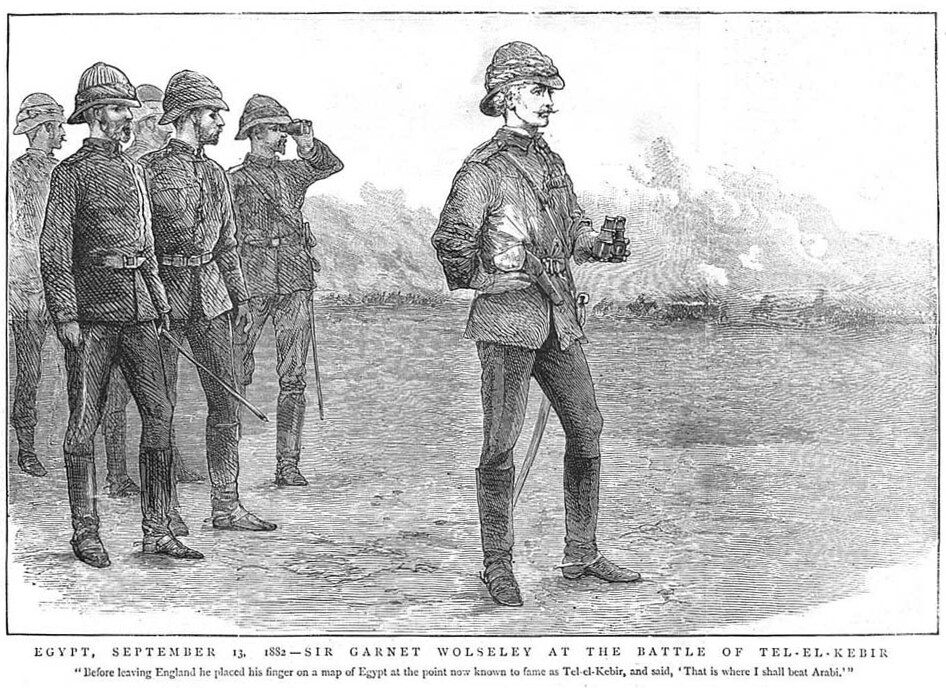
The man who conceived and executed this audacious operation was General Sir Garnet Wolseley. The victory he won that morning handed Britain effective control of Egypt and secured the Suez Canal — the jugular vein of the entire British Empire.
Egypt in Crisis: The Road to War
By 1881, Egypt was gripped by a deepening nationalist crisis. Colonel Ahmed Urabi, a charismatic army officer from a peasant background, had rallied growing numbers of Egyptians against foreign financial control and the rule of the pro-British Khedive Tewfik. His movement was not simply military rebellion — it tapped into genuine popular anger.
Britain and France had jointly managed Egypt's finances since the country defaulted on its debts in the 1870s, and the resentment this generated was explosive. In June 1882, riots in Alexandria left around 50 Europeans dead, sending alarm through the government of Prime Minister William Gladstone in London.
On 11 July 1882, the Royal Navy bombarded Alexandria's coastal forts, signalling Britain's open military intervention. France, despite its shared financial interests, declined to participate — a fateful decision that would cement decades of British dominance over Egypt and leave France permanently aggrieved over a country it considered within its own sphere of influence.
Sir Garnet Wolseley: The Man Called 'Our Only General'
Born in County Dublin in 1833, Sir Garnet Wolseley had seen more active service by middle age than most officers saw in an entire career. He had fought in Burma, the Crimea, the Indian Mutiny, and China, and had led expeditions in Canada and West Africa. His Red River Expedition of 1870 — a logistically remarkable operation in the Canadian wilderness — and the Ashanti campaign of 1873–74 made him a household name.
Gilbert and Sullivan immortalised him, thinly veiled, as the inspiration for 'the very model of a modern Major-General' in The Pirates of Penzance (1879). That a satirical comic opera chose him as its reference point tells you everything about his celebrity status in Victorian Britain.
Wolseley was appointed commander of the Egyptian Expeditionary Force in July 1882. He was famous not only for his own abilities but for the tight circle of talented officers he gathered around him — men like Redvers Buller and Evelyn Wood — who became known as the 'Wolseley Ring.' Together they represented the reforming, professional edge of the Victorian British Army.
Urabi's Defences: The Egyptian Position at Tel el-Kebir
Colonel Urabi had chosen his ground carefully. Tel el-Kebir was a low ridge running roughly four miles wide across the desert, positioned to block the main railway and the Sweet Water Canal — the two vital arteries leading to Cairo. His engineers had spent weeks throwing up earthworks standing up to six feet high and nine feet thick, reinforced with artillery emplacements and interconnected trenches.
The Egyptian army at Tel el-Kebir numbered approximately 22,000 men and was equipped with modern Krupp artillery and rifles. By the standards of a mid-Victorian colonial opponent, it was a formidable force — far better armed than the Ashanti or the Zulus Wolseley had faced before.
Urabi held one critical assumption: that the flat, featureless desert surrounding his position made a large-scale surprise attack effectively impossible. Dust clouds, noise, and the difficulty of navigating by night would, he believed, give his sentries ample warning. It was a reasonable assumption. Wolseley intended to prove it wrong.
Wolseley's Master Plan: The Night March
A frontal daylight assault on Tel el-Kebir's earthworks would have been murderous. Wolseley instead planned something far bolder: a silent night march timed to bring his entire force to the Egyptian parapet at the precise moment of first light on 13 September 1882.
The British force — approximately 11,000 infantry, 2,000 cavalry, and 60 guns — would have to navigate seven miles of flat, featureless desert in complete darkness without compass bearings being sufficient alone. Wolseley turned to the Royal Navy for a remarkable solution. Captain William Hewett was tasked with guiding the columns using stellar observation, essentially steering an army of thousands by the stars as if navigating a ship at sea.
Strict orders governed every soldier on the march. No talking. No smoking. Weapons were not to be loaded until the final approach to the Egyptian lines. The penalty for noise was severe — a single sentry's alarm could unravel the entire operation.
The Highland Brigade — comprising the Black Watch, the Gordon Highlanders, and the Cameron Highlanders — was assigned the critical left flank of the assault. To their right would be the Guards Brigade and the Indian Contingent, tasked with sweeping around the Egyptian right to cut off any retreat toward Cairo.
35 Minutes of Battle: The Assault on the Egyptian Lines
At approximately 5:00 a.m. on 13 September, the British columns reached the Egyptian earthworks. The darkness had held. The silence had held. The surprise was almost total.
The Highland Brigade, commanded by Major-General Archibald Alison, stormed the left section of the Egyptian line with bayonets fixed, crossing the ditches and scaling the earthworks before most defenders had fully roused themselves. Egyptian artillery opened fire, but the guns were unable to depress quickly enough — British infantry were already inside the trenches before the defenders could organise a coherent response.
The fighting inside the earthworks was vicious and close. The Highlanders used their bayonets in the confined trenches, driving through the Egyptian positions with the momentum of complete surprise behind them. On the right flank, units of the Indian Contingent — including Bengal Cavalry and Bombay Infantry — swept wide to cut off the Egyptian line of retreat toward Cairo.
Within 35 minutes, the entire Egyptian defensive line had collapsed. Urabi's forces broke and fled westward toward Cairo in disarray, abandoning artillery, equipment, and their carefully prepared fortifications. What had taken weeks to build was destroyed in half an hour.
Casualties and Capture: The Human Cost
British losses were remarkably — almost shockingly — light given the scale of the operation. Approximately 57 men were killed and 382 wounded. Those numbers speak directly to the effectiveness of the surprise achieved.
Egyptian casualties were far heavier. Estimates vary, but figures of between 2,000 and 3,000 killed, wounded, or captured are generally cited, with the majority of losses occurring during the rout after the line broke rather than in the initial assault itself.
Urabi escaped the battlefield but did not get far. British cavalry — the 4th Dragoon Guards — raced along the railway toward Cairo. Urabi surrendered on 14 September 1882. He was subsequently tried, with his life ultimately spared after significant diplomatic pressure, and exiled to Ceylon (modern Sri Lanka), where he lived until 1901. Cairo itself fell to British forces on 15 September — just two days after the battle — bringing the military phase of the campaign to a close with startling speed.
Aftermath: Britain's Occupation of Egypt
The victory at Tel el-Kebir established a British military and political presence in Egypt that would endure, in various forms, for over seventy years. Wolseley returned home to a hero's welcome — Parliament passed a vote of thanks in his honour, and the government awarded him £30,000, a vast sum at the time.
The Suez Canal, opened in 1869 and already critical to trade and troop movements between Britain and India, came under effective British protection. For an empire that depended on rapid communication with its eastern possessions, this was a strategic prize of incalculable value.
Egypt nominally remained part of the Ottoman Empire, but real power now rested with British officials. The most consequential of these was Evelyn Baring, appointed Consul-General in 1883 and later ennobled as Lord Cromer. For the next two decades, Cromer effectively ran Egypt — managing its finances, reforming its administration, and ensuring British interests came first.
The occupation was not without long-term consequences. It sowed the seeds of Egyptian nationalism that would simmer and grow through the early twentieth century, eventually boiling over in the 1952 revolution that brought Gamal Abdel Nasser to power — and four years later in the Suez Crisis of 1956, which finally ended Britain's position in Egypt altogether.
Legacy: Why Tel el-Kebir Still Matters
Tel el-Kebir stands as a masterclass in combined-arms planning. The use of Royal Navy expertise for navigation, the precise coordination of infantry, cavalry, and artillery, the iron discipline of the night march — all of it worked in near-perfect concert. Wolseley's methods were studied at Sandhurst for a generation after 1882.
Yet the battle is largely forgotten today, overshadowed in popular memory by the drama of the Zulu War, the tragedy of Gordon at Khartoum, or the campaigns on the North-West Frontier. This is a strange kind of historical amnesia, because the geopolitical consequences of Tel el-Kebir were arguably greater than any of those better-remembered conflicts.
The campaign also illustrated something important about the limits of Victorian imperial power. A brilliantly executed military victory could not by itself resolve the deep political tensions that had produced Urabi's rebellion in the first place. Britain won the battle decisively but never fully won the consent of the Egyptian people — a lesson that would echo down through the following century.
For regimental historians, Tel el-Kebir lives on as a battle honour carried by the successors of the Highland regiments, the Royal Irish Fusiliers, and several former Indian Army units to this day. It remains a reminder that the Victorian British Army, at its best, was capable of extraordinary feats of planning, discipline, and audacity.
Further Reading
- The National Army Museum, London — holds significant collections relating to Victorian campaigns including the Anglo-Egyptian War of 1882
- The National Archives, Kew — primary source records for British military operations and War Office papers from the 1882 campaign
- The Imperial War Museum, London — archives and research resources covering British military history from the late nineteenth century onward
- The British Library — holds contemporary newspaper accounts, official dispatches, and personal memoirs relating to Wolseley and the Egyptian Expeditionary Force
- The Scottish United Services Museum (part of the National Museums Scotland) — regimental histories and collections relating to the Highland Brigade's role at Tel el-Kebir