The Quiz Question
Which Confederate commerce raider, captained by Raphael Semmes, was sunk by the USS Kearsarge off the coast of France in June 1864 after a famous ship-to-ship duel?
- A. CSS Alabama
- B. CSS Shenandoah
- C. CSS Florida
- D. CSS Sumter
The answer is A. CSS Alabama. Here is the full story.
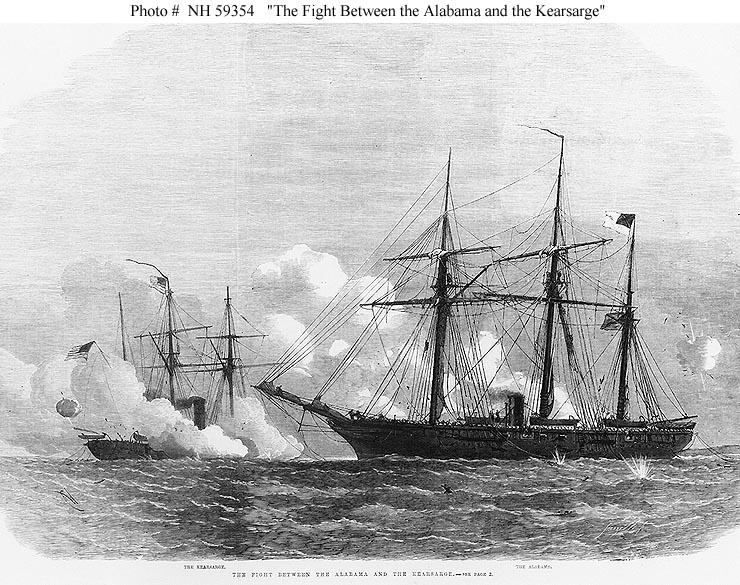
On a bright Sunday morning in June 1864, thousands of spectators climbed the cliffs above Cherbourg, France, and trained their telescopes on the waters below. They had come to watch two warships kill each other. What unfolded in the next 90 minutes would become one of the most dramatic — and most witnessed — naval engagements in American history.
A Sunday Battle the Whole World Watched
The 19th of June 1864 drew an extraordinary crowd to the Normandy coast. Pleasure boats and private yachts sailed out into the English Channel to get closer to the action, their passengers jostling for the best view as if at a regatta. It was, in its terrible way, a spectacle — and the people of Cherbourg treated it as one.
Among the observers on shore was the French painter Édouard Manet, who later immortalised the scene in his celebrated 1864 oil painting The Battle of the Kearsarge and the Alabama. His canvas captures the smoke, the churning sea, and the human scale of the disaster — small lifeboats pulling desperately through the waves as one of the great commerce raiders of the American Civil War slipped beneath the surface.
This was no forgotten skirmish. The engagement lasted just 90 minutes, but its outcome crystallised the decline of Confederate sea power and reverberated in diplomatic circles on both sides of the Atlantic for years to come. The world had watched, and the world took note.
What Was CSS Alabama — and Why Did She Matter?
CSS Alabama was a steam-powered sloop-of-war built in secret at the Laird Brothers shipyard in Birkenhead, England. She was launched on 15 May 1862 under the discreet cover name "Hull 290," her true purpose concealed from British authorities who were nominally bound by neutrality obligations.
She was commissioned into Confederate service on 24 August 1862 off the Azores, armed with eight guns — among them a formidable 100-pound Blakely rifle and a 68-pound smoothbore cannon. Her mission was not to seek out Union warships and destroy them, but to hunt Northern merchant shipping and bleed the Union economy through attrition. It was naval guerrilla warfare on a global scale.
Over 22 months at sea, Alabama captured or destroyed 65 Union merchant vessels, causing an estimated $6 million in damage — equivalent to hundreds of millions of dollars today. She ranged across the Atlantic, the Gulf of Mexico, the Indian Ocean, and beyond, and she never once entered a Confederate port during her entire commission. She was, in every practical sense, a ship without a home.
The Man at the Helm: Captain Raphael Semmes
Raphael Semmes was born in Charles County, Maryland, in 1809 and had served in the U.S. Navy for more than 30 years before resigning his commission and offering his services to the Confederacy in 1861. He brought with him a wealth of practical seamanship and an acute legal mind.
He had already made his name before Alabama. As commander of CSS Sumter, he captured 18 Union vessels before the ship was blockaded at Gibraltar and had to be abandoned. When he took command of Alabama, he was already a figure of notoriety in Northern newspapers and quiet admiration in Southern ones.
His crew called him "Old Beeswax" — a reference to his trademark waxed moustache — and the nickname was worn with affectionate irreverence. Semmes was demanding and meticulous, but he held to a strict code: before destroying any captured vessel, he ensured the safety of its crew. That discipline earned him a grudging respect even among Union officers who hunted him across three oceans.
He was also a gifted writer. His memoir, published after the war, offers one of the most vivid firsthand accounts of commerce raiding ever committed to paper — and his portrait of life aboard Alabama remains essential reading for students of Civil War naval history.
Into Cherbourg: Alabama's Final Port of Call
By the summer of 1864, Alabama was wearing out. Two years of continuous sea service had taken a heavy toll on her boilers, her hull was fouled below the waterline, and her crew was exhausted. She desperately needed time in a dry dock.
Semmes sailed into the French naval port of Cherbourg on 11 June 1864, requesting permission from French authorities to carry out essential maintenance. Napoleon III's government stalled on the request, wary of the diplomatic implications of allowing a Confederate warship access to a French military facility.
Word reached USS Kearsarge, then anchored at Flushing in the Netherlands, within days. Her commander, Captain John A. Winslow, set course for Cherbourg immediately. Kearsarge arrived on 14 June and took up a position just outside French territorial waters — a neat piece of strategic positioning that effectively blockaded Alabama in port without a single shot being fired.
Semmes now faced an unpalatable choice: allow his ship to be interned indefinitely, or come out and fight.
The Challenge: Semmes Decides to Fight
Semmes chose to fight. On 14 June 1864, he sent a formal challenge through the Confederate agent in Cherbourg, asking Kearsarge to remain offshore — he would give battle on the following Sunday, the 19th. It was a gesture as much theatrical as tactical, and it captured the imagination of the watching world.
What Semmes did not know was that Winslow had taken a quiet but brilliant precaution. He had draped anchor chains along Kearsarge's sides — at the most vulnerable points near the engine room and magazines — and covered them with wooden planking to disguise their presence. This improvised armour was simple, unglamorous, and devastatingly effective.
Before departing Cherbourg harbour, Semmes addressed his crew on the deck of Alabama. He reminded them they were fighting not just for the Confederacy but for their honour as sailors. The speech was met with three cheers. Then they made ready for battle.
The Battle: 90 Minutes That Shook the Atlantic
At approximately 10:57 a.m. on 19 June 1864, Alabama cleared Cherbourg harbour under escort from a French ironclad, which peeled away at the three-mile territorial limit. The watching crowds onshore held their breath.
The two ships engaged in an unusual circular pattern, each captain attempting to rake the other's bow or stern to maximise damage while minimising exposure. They completed seven full circles as they fought — a choreography unlike anything in the traditional line-of-battle engagements of an earlier era, and a vivid demonstration of how steam power was reshaping naval tactics.
Alabama fired around 370 shells during the engagement, but many failed to detonate due to faulty Confederate ammunition — a critical weakness that haunted Southern naval operations throughout the war. Only 28 rounds struck Kearsarge with any real effect. By contrast, Kearsarge's 11-inch Dahlgren guns, far heavier than anything Alabama carried, punched through the Confederate raider's hull with devastating consistency. The chain armour absorbed dozens of hits that might otherwise have settled the battle much sooner — and in Kearsarge's favour regardless.
After 90 minutes, Alabama was sinking. At around 12:24 p.m., Semmes ordered the Confederate ensign struck and a white flag raised. Then — in a gesture that became one of the enduring images of the engagement — he threw his sword into the sea rather than surrender it. Within minutes, Alabama slipped beneath the surface.
Rescue, Escape, and Controversy
As Alabama went down, Kearsarge launched boats to pull survivors from the water. But the rescue operation was immediately complicated by the arrival of the English steam yacht Deerhound, owned by Lancashire cotton merchant John Lancaster, who had sailed out from Cherbourg to watch the battle.
Deerhound pulled Semmes and 41 of his crew from the Channel — and then, controversially, made straight for Southampton rather than transferring the rescued men to Kearsarge. Semmes had escaped capture. Captain Winslow was furious, arguing that Lancaster had violated the norms of maritime rescue by effectively removing prisoners of war. Lancaster maintained he owed no such obligation and had simply rescued men from the sea.
The human cost of the battle was strikingly lopsided. Nine Confederate sailors were killed and 21 wounded; Kearsarge suffered only three wounded and no fatalities. The chain armour — that simple, unglamorous innovation — had made the difference between a close-run contest and a one-sided defeat.
Alabama sank in approximately 60 metres of water, roughly 11 kilometres from Cherbourg. Her wreck lay undiscovered until 1984, when French navy divers finally located her remains on the Channel floor.
Aftermath: The Alabama Claims and International Law
The sinking of Alabama did not close the book on her story — it opened a new and deeply consequential chapter. The United States government held Britain responsible for allowing Alabama and other Confederate commerce raiders to be constructed in British shipyards, in clear violation of neutrality obligations. The diplomatic dispute that followed would occupy both governments for nearly a decade.
In 1872, an international arbitration tribunal convened in Geneva specifically to adjudicate the so-called Alabama Claims. The tribunal ruled against Britain and ordered payment of $15.5 million in gold to the United States — a landmark decision in the history of international law. It established that neutral nations bore real legal responsibility for the actions of warships built within their borders, and it helped lay the groundwork for modern frameworks of international dispute resolution.
Raphael Semmes returned quietly to the Confederacy after his rescue. He was briefly arrested after the war ended but was never brought to trial. He eventually returned to practising law in Mobile, Alabama, and in 1869 published his celebrated memoir Memoirs of Service Afloat — a work that remains in print and in use by historians to this day.
Legacy: Why the Duel off Cherbourg Still Resonates
The wreck of CSS Alabama was formally designated a protected historical site under a 1989 Franco-American agreement. Archaeological dives in subsequent years have recovered significant artefacts, many of which are now displayed at Cherbourg's Cité de la Mer museum — a fitting resting place for relics of a ship that spent her entire commission far from Confederate shores.
The battle is still studied in naval academies as a masterclass in improvised engineering — specifically, the use of Kearsarge's chain armour — and for its lessons in how circular engagement tactics could neutralise a faster, more manoeuvrable opponent. Alabama's two-year campaign also had a long economic tail: her depredations effectively drove much of the U.S. merchant marine to sail under foreign flags, a shift in American maritime trade that persisted for decades after the war ended.
For students of the American Civil War, the engagement off Cherbourg stands as a moment where industrial ingenuity, personal courage, and geopolitical consequence converged in a single dramatic afternoon. Semmes — demanding, principled, and doomed — remains one of the war's most compelling figures: a man who fought with honour on the wrong side of history, on a ship the world could not stop watching.
The Alabama vs Kearsarge duel is also a reminder that the Civil War was never purely a continental conflict. It was fought in the Indian Ocean and the English Channel as much as on the fields of Virginia — and its consequences were felt in the corridors of European governments long after the guns fell silent at Appomattox.
If this story captured your imagination, we'd love to hear your thoughts — drop a comment below, share this article with a fellow history enthusiast, or tell us which aspect of Civil War naval history you'd like us to explore next.
Further Reading
- National Museum of the U.S. Navy, Washington D.C.
- The National Archives (United States), including Civil War naval records
- Smithsonian Institution — American history collections
- Cité de la Mer, Cherbourg — CSS Alabama artefact collection
- Library of Congress — Civil War era maritime documents and photograph collections