The Quiz Question
Which British special forces unit destroyed eleven Argentine aircraft in a night raid on Pebble Island in May 1982?
- A. The SAS
- B. The Parachute Regiment
- C. The Gurkhas
- D. The Royal Marines
The answer is A. The SAS. Here is the full story.
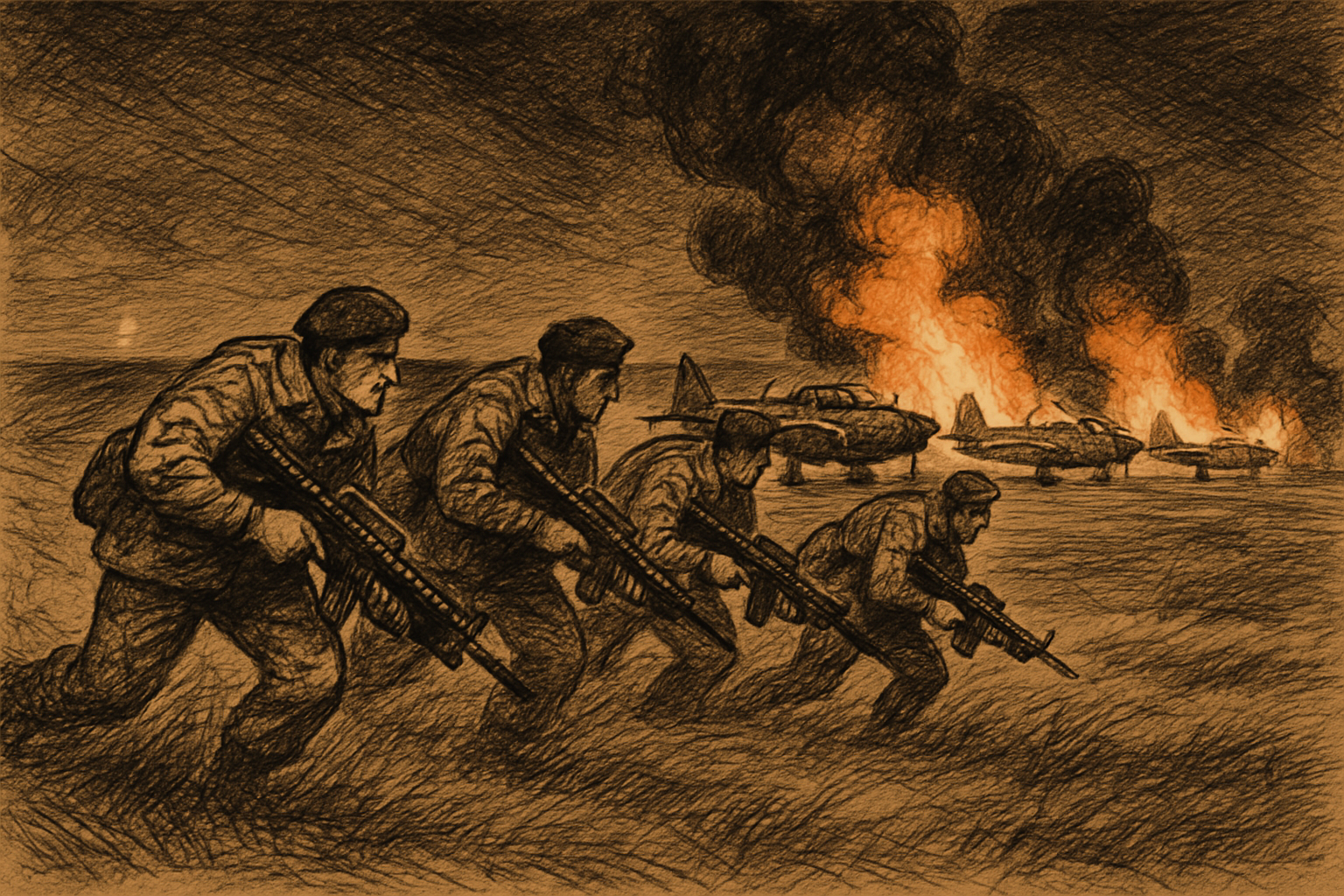
In the early hours of 15 May 1982, a small force of British special forces soldiers sprinted across a windswept airstrip in the South Atlantic and methodically destroyed eleven Argentine aircraft in under thirty minutes. No British lives were lost. By the time the sun rose over the Falkland Islands, the strategic picture had shifted decisively in Britain's favour. The Pebble Island raid remains one of the most audacious and perfectly executed special forces operations in modern British military history.
One Night, Eleven Aircraft, and a War Turned on Its Head
Operation Prelim, as the raid was officially codenamed, was launched on the night of 14 to 15 May 1982, with 45 men from D Squadron, 22 SAS Regiment at its heart. Their objective was simple in outline but demanding in execution: destroy every Argentine aircraft on Pebble Island's forward airstrip before the main British amphibious landings could begin.
When it was over, six FMA IA 58 Pucará ground-attack aircraft, four Beechcraft Mentor trainers, and one Short Skyvan transport aircraft had been destroyed or rendered permanently unserviceable. The cost to the British side was two men wounded — not one killed.
The timing was not coincidental. The amphibious landings at San Carlos Bay — Operation Sutton — were scheduled for 21 May, just six days away. British commanders at Northwood and aboard HMS Hermes knew that if those aircraft were still operational when troops hit the beaches, the consequences could be catastrophic.
News of the raid electrified the British public. For a nation gripped by anxiety about a war being fought 8,000 miles from home, the message from Pebble Island was unmistakable: Britain's special forces could strike where they chose, when they chose, and walk away clean.
Why Pebble Island Mattered: The Strategic Threat Argentina Had Built
Pebble Island sits off the northern coast of West Falkland, separated from the main island by Tamar Pass. It is remote, windswept, and — in 1982 — home to a small farming settlement and a grass airstrip that Argentine forces had converted into a forward operating base shortly after the invasion in April.
The Pucarás stationed there represented a genuine and specific threat. Designed for low-level counter-insurgency operations, they were optimised for exactly the kind of attacks that could devastate landing craft, helicopters, and troops moving ashore in the exposed waters of Falkland Sound.
Argentine commanders were under no illusions that a British amphibious assault was coming. Positioning the Pucarás on Pebble Island placed them within easy striking range of the likely landing zones, and the island's location also gave Argentina a vantage point for monitoring British naval movements through Falkland Sound — the very corridor the Task Force would need to transit.
British planners identified the Pebble Island garrison as a priority target that had to be neutralised before D-Day. The question was how to do it quietly, quickly, and without triggering a wider engagement that might compromise the secrecy of the landings.
The SAS Moves First: Reconnaissance and Planning
Several days before the raid, a four-man patrol from D Squadron's Boat Troop was covertly inserted onto Pebble Island to carry out close-target reconnaissance. Moving by night and lying up by day in the island's rough terrain, these men confirmed the exact number and types of aircraft on the strip, mapped Argentine defensive positions, and identified the safest approach routes for the assault teams.
The information they gathered was critical. Without it, the raiding party would have been operating blind against an unknown defensive layout — an unacceptable risk given the scale of what was at stake.
Commanding D Squadron on the ground was Major Cedric Delves, an experienced and respected special forces officer. The broader naval coordination fell under Rear Admiral Sandy Woodward's Task Force, with HMS Hermes — the flagship — serving as the launch platform for the operation.
Planning was made significantly more difficult by the brutal weather around the islands and the extremely narrow window of darkness available to the raiding party. The South Atlantic winter meant high winds, low visibility, and the ever-present risk of hypothermia. Every minute counted once boots were on the ground.
The Raid: Inside 30 Minutes of Controlled Chaos
As darkness fell on 14 May 1982, 45 SAS troopers boarded Sea King helicopters aboard HMS Hermes and lifted off into the South Atlantic night. The insertion was tense — sea conditions were rough, the weather was marginal, and any navigational error could compromise the entire operation before it began.
Naval gunfire support was provided by HMS Glamorgan, whose 4.5-inch guns began pounding Argentine positions on the high ground around the airstrip as the assault teams moved in. The bombardment served a dual purpose: suppressing defensive fire and forcing Argentine soldiers to keep their heads down while the SAS went to work on the aircraft.
The troopers moved swiftly and systematically from aircraft to aircraft, placing demolition charges and using small arms fire to ensure total destruction. The Argentine garrison — estimated at between 100 and 150 men — was kept pinned by the combination of naval fire and the ferocious firepower of the SAS assault teams.
Despite pockets of fierce resistance, the entire operation from first contact to extraction was completed in approximately 30 minutes. The SAS withdrew under fire as the first grey light of dawn began to appear on the horizon, extracted by the waiting Sea Kings back to Hermes. Eleven aircraft burned behind them on the strip.
The Men Who Did It: D Squadron SAS in 1982
D Squadron, 22 SAS Regiment was the primary special forces unit deployed to the South Atlantic for the Falklands campaign, and the Pebble Island raid was far from their only operation during those critical weeks. They were conducting covert reconnaissance missions across East and West Falkland throughout May, feeding intelligence back to the Task Force.
Many of the men who hit Pebble Island were veterans of Northern Ireland and the Dhofar campaign in Oman — soldiers who had spent years operating in environments where mistakes meant death. That experience showed in the clinical efficiency of the raid.
The squadron had already suffered a devastating blow earlier in the campaign. On 19 May — just four days after Pebble Island — a Sea King helicopter crashed into the sea during a cross-decking transfer between ships, killing 18 SAS soldiers. It remains the regiment's single worst loss of life in a single incident. The men who raided Pebble Island did so knowing the risks the South Atlantic environment posed were lethal even before a shot was fired.
The operation succeeded because of years of rehearsal, iron discipline under fire, and the kind of mutual trust between men that only comes from shared hardship and sustained professional training.
Casualties and Costs: What the Raid Actually Cost Both Sides
The SAS came off Pebble Island with two men wounded — Corporal Paul 'Pablo' Stretton among them — but no fatalities. Given the scale and speed of the assault, against a garrison more than twice the size of the raiding party, that outcome was remarkable.
Argentine casualties on the ground were estimated at approximately six killed, though Argentine military records from the conflict are incomplete in places and the precise figure has been disputed in the years since. What is not disputed is the material damage: all eleven aircraft were confirmed destroyed.
HMS Glamorgan expended a significant quantity of 4.5-inch ammunition during the operation, underscoring the level of combined-arms coordination involved. Naval gunfire support is a complex and high-risk undertaking — the margin between suppressing the enemy and hitting your own men is a matter of metres and seconds.
For Argentina, the loss of the Pebble Island aircraft was irreplaceable. With supply lines stretched across 400 miles of ocean to the mainland, there was no realistic prospect of reinforcing the island-based air capability before the British landings began.
The Wider Impact: How Pebble Island Shaped the San Carlos Landings
When Operation Sutton began in the early hours of 21 May 1982, British commanders had already removed one of the most credible threats to the landing force. The Pucarás that should have been waiting to pounce on vulnerable landing craft and helicopters in Falkland Sound were smoking wreckage on Pebble Island's airstrip.
The Argentine air attacks that did hit the San Carlos landings were devastating — HMS Ardent, HMS Antelope, and HMS Coventry were all lost in the days that followed — but they came from mainland-based Skyhawks and Super Étendards, not from island-forward Pucarás. The difference in response time and loiter capability was significant.
Brigadier Julian Thompson, who commanded 3 Commando Brigade during the landings, later described the destruction of the Pebble Island aircraft as a vital contribution to making the San Carlos operation viable. That assessment carries weight: Thompson was in the best possible position to judge what those aircraft could have done to his men on the beaches.
The psychological impact of the raid was also lasting. Argentine forces across the islands knew after Pebble Island that no position was beyond the reach of British special forces — a corrosive uncertainty that complicated Argentine defensive planning for the remainder of the campaign.
Argentina's Pucará: The Aircraft the SAS Had to Destroy
The FMA IA 58 Pucará was a twin-turboprop ground-attack aircraft designed and built in Argentina, specifically optimised for counter-insurgency and low-level strike missions. It was armed with two 20mm Hispano cannon and four 7.62mm FN machine guns, and could carry a substantial load of rockets and bombs on underwing pylons.
Its relatively slow speed and ability to operate from short, unprepared strips made it well-suited to the Falklands environment — and ideally configured to attack exactly the kinds of targets the British were landing: troops in the open, logistics vehicles, light vessels, and helicopters.
The threat was not theoretical. On 28 May, during the Battle of Goose Green, a Pucará destroyed a British Army Gazelle helicopter, killing its crew. That single incident illustrated precisely what the Pebble Island Pucarás might have done had they been operational during the San Carlos landings — against far more numerous and concentrated targets.
The SAS did not destroy eleven nuisance aircraft that night. They destroyed eleven potential instruments of mass casualties among the men of 3 Commando Brigade.
Legacy and Memory: Why Pebble Island Still Resonates Forty Years On
The Pebble Island raid has taken its place alongside the Iranian Embassy Siege of 1980 and the Bravo Two Zero mission of 1991 in the public memory of SAS operations. It represents a near-perfect example of a special forces raid achieving its objectives with minimum force and maximum effect — the kind of operation that military planners study and aspire to replicate.
It is taught at military academies as a model of combined-arms special operations: covert close-target reconnaissance feeding directly into a coordinated assault, with naval gunfire and helicopter mobility integrated seamlessly into the ground action. Each element depended on the others, and each executed its role with precision.
A memorial on Pebble Island marks the site of the old airstrip, and the island has become one of the Falklands' most visited historical destinations for veterans, their families, and history enthusiasts making the long journey to the South Atlantic.
For the generation who watched events unfold on their television screens in the spring of 1982 — who followed the Task Force's progress on maps pinned to kitchen walls and anxiously read each morning's newspaper — Pebble Island represents one of the moments when the outcome felt, for the first time, genuinely possible. A small group of extraordinary soldiers had gone in the dark, done what needed to be done, and come home. In a war full of hard days, that mattered enormously.
Further Reading
- Imperial War Museum — holds extensive collections related to the Falklands War, including personal testimonies, equipment, and official records
- The National Archives (Kew) — official British government and military documents from the 1982 Falklands campaign, including operational records declassified in subsequent decades
- National Army Museum (London) — collections covering British Army operations in the Falklands, including material related to special forces deployments
- Fleet Air Arm Museum (Yeovilton) — records and artefacts relating to Royal Navy aviation operations during the South Atlantic conflict, including Sea King operations
- Falklands Islands Museum and National Trust (Stanley) — the primary in-islands archive for the history of the 1982 conflict and its aftermath