The Quiz Question
Which November 1983 NATO command post exercise simulating a nuclear release procedure was later revealed to have brought the Soviet Union closer to fearing a real preemptive nuclear strike than at almost any other point in the Cold War?
- A. Able Archer 83
- B. Exercise Reforger
- C. Operation Praying Mantis
- D. Exercise Team Spirit
The answer is A. Able Archer 83. Here is the full story.
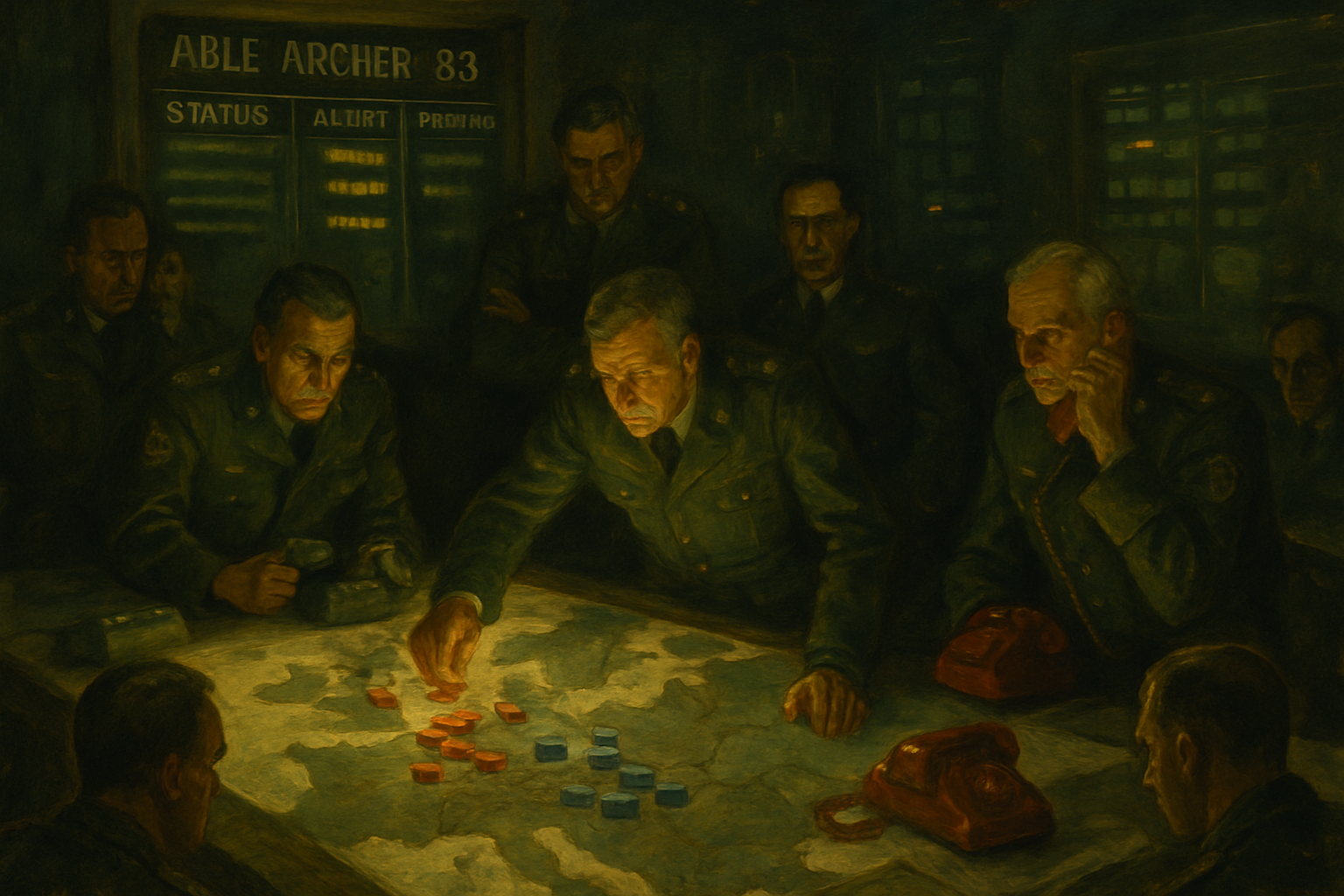
For ten days in November 1983, the world stood closer to nuclear war than at almost any point since the Cuban Missile Crisis. There were no televised addresses, no naval blockades, no breathless news bulletins. Just a NATO military exercise unfolding quietly across Western Europe — and a group of Soviet intelligence officers who genuinely believed they might be watching the opening moves of an American first strike.
The crisis was so secret that most Western governments, including senior British cabinet ministers, had no idea how close things had come until years later. When declassified documents finally emerged in the 1990s and 2000s, historians were shaken. Able Archer 83 had been, in the words of the President's own intelligence advisory board, a genuine — if entirely inadvertent — near-miss.
The Cold War in 1983: A World on a Hair Trigger
To understand why a NATO exercise could frighten Moscow to the edge of a pre-emptive strike, you need to understand just how volatile the international atmosphere had become by the autumn of 1983.
In March of that year, President Ronald Reagan had publicly labelled the Soviet Union an "Evil Empire" — language that sent alarm bells ringing in the Kremlin about American intentions. Then, on 1 September 1983, Soviet air defences shot down Korean Air Lines Flight 007 after it strayed into Soviet airspace, killing all 269 people aboard. The international furore that followed made an already poisonous relationship significantly worse.
In November, NATO began deploying Pershing II ballistic missiles to West Germany. Soviet planners calculated these missiles could reach Moscow in as little as six minutes — barely enough time to react, let alone retaliate. The pressure on the Soviet military to detect any sign of an incoming strike, and to detect it early, was immense.
The KGB and Soviet military intelligence (GRU) were already running a global intelligence-gathering programme called RYAN — an acronym for Raketno-Yadernoye Napadenie, meaning Nuclear Missile Attack. RYAN was designed specifically to identify the early indicators of an American first strike, from unusual troop movements to changes in blood bank stocks. Soviet analysts were trained to look for combinations of signals. In November 1983, they found them.
Soviet leader Yuri Andropov, gravely ill and largely confined to his bed by this point, was deeply paranoid about Western intentions. A former KGB chairman himself, he placed enormous trust in RYAN's findings — and the men running RYAN were under institutional pressure to report threats, not to discount them.
What Was Able Archer 83? The Exercise Explained
Able Archer 83 was an annual NATO command post exercise, running from 7 to 11 November 1983. Its purpose was to practise the precise procedures for authorising and releasing nuclear weapons in the event of a Soviet attack — an essential rehearsal for an alliance whose entire defensive posture rested on the credibility of nuclear deterrence.
The exercise was organised under Supreme Headquarters Allied Powers Europe (SHAPE) and involved commands across Britain, West Germany, the Netherlands, and other NATO member states. Ground forces, air commands, and political structures were all incorporated into the scenario.
The 1983 edition was significantly more realistic than previous years. It simulated a full escalation from conventional warfare through to a nuclear release, using new, more authentic communication formats and procedures. Crucially, it incorporated realistic radio silences — periods where NATO went deliberately quiet — and changes to communication patterns that were designed to mirror what would actually happen in a real war.
For the first time, the exercise simulated the involvement of heads of state, including President Reagan and Prime Minister Margaret Thatcher, in the nuclear release decision chain. Participating units were instructed to use only the actual nuclear release procedures that would be employed in a genuine war. This made the exercise extraordinarily hard for Soviet eavesdroppers to distinguish from the real thing.
The Soviet Response: Genuine Fear at the Highest Levels
KGB and GRU listening posts across Europe monitored NATO communications closely throughout early November 1983. What they intercepted alarmed them deeply. RYAN analysts noted the unusual communication formats, the extended radio silences, and the apparent involvement of very senior political figures — all indicators that their protocols flagged as potential precursors to an attack.
Soviet military units in Eastern Europe, including elements based in East Germany and Poland, were placed on heightened alert. Some Warsaw Pact nuclear-capable aircraft were reportedly readied for action — an extraordinary step during what NATO considered a routine training exercise.
The KGB Residency in London sent urgent cables to Moscow Centre describing the exercise in alarming terms. The London station's reporting was among the most urgent received during the entire Able Archer period. Officers in the field were not performing concern for their superiors' benefit. The fear, as events would later confirm, was genuine.
Oleg Gordievsky: The Spy Who May Have Saved the World
Oleg Gordievsky was a senior KGB officer stationed in London who had been secretly passing intelligence to British MI6 since 1974. His position gave him an extraordinary window into Soviet thinking — including the real state of mind within the KGB during the Able Archer crisis.
Gordievsky reported to his MI6 handlers that Soviet anxiety about the exercise was real and acute. This was not propaganda or bluster designed to unnerve the West. Officers genuinely believed that war might be imminent. His intelligence was passed to the CIA and eventually reached President Reagan.
Reagan was reportedly genuinely shocked. According to his own diary entries from the period, he had not understood that his rhetoric and America's military posture were generating such acute fear in Moscow. The idea that Soviet leaders truly believed the United States might launch a first strike was, by his own account, deeply unsettling to him.
Gordievsky was eventually exfiltrated from the Soviet Union in a dramatic MI6 operation in July 1985. He was smuggled out of Moscow in the boot of a British Embassy car — one of the most audacious intelligence extractions of the entire Cold War. His subsequent debriefings, and the memoir he later published, became central to how the West came to understand just how dangerous November 1983 had truly been.
Britain's Role: Thatcher, GCHQ, and a Special Relationship Under Pressure
Britain was not a passive bystander during Able Archer 83. RAF bases across the country were central to NATO's nuclear posture, with American F-111 nuclear strike aircraft based at Lakenheath and Mildenhall in Suffolk. British territory was directly implicated in the scenario the exercise was rehearsing.
The Government Communications Headquarters — GCHQ, based in Cheltenham — was monitoring Soviet signals throughout November 1983 and contributed vital intelligence about Moscow's reaction to the exercise. It was British intelligence, shaped by Gordievsky's reporting, that first gave the West a clear picture of how seriously the Soviets had taken Able Archer.
Prime Minister Margaret Thatcher received those intelligence assessments and was sufficiently alarmed to raise the matter directly with President Reagan. She urged him to find ways to reassure Moscow without publicly signalling any retreat from NATO's defensive posture — a delicate diplomatic needle to thread.
Thatcher's intervention is credited by a number of historians as a key factor in nudging Reagan toward a more conciliatory tone. Within months, Reagan was delivering speeches pledging that "a nuclear war cannot be won and must never be fought." The shift in language was notable, and its roots lay at least partly in the autumn of 1983.
Behind the scenes, British officials were frustrated. American planners had made Able Archer 83 considerably more realistic than previous exercises without fully consulting allies about how Moscow might interpret the changes. That friction — quiet, diplomatic, but real — added a brief chill to the Special Relationship.
How the Crisis Passed — And Why Nobody Knew
Able Archer 83 ended on schedule on 11 November 1983 — Armistice Day. As NATO communications returned to their normal patterns, Soviet forces stood down from their heightened alert. The crisis dissolved as quietly as it had begun.
Because the entire episode had played out in classified intelligence channels on both sides, neither the public nor most politicians had any idea how close things had come. The governments of Western Europe had just sleepwalked to the edge of a nuclear confrontation, and almost no one knew.
The President's Foreign Intelligence Advisory Board (PFIAB) produced a classified report in 1990 concluding that Able Archer 83 had posed a genuine, if inadvertent, risk of triggering a Soviet pre-emptive strike. British and American government documents relating to the episode were not declassified until the late 1990s and 2000s, with some files remaining restricted well into the 2010s. Soviet and Russian archives have never been fully opened on Able Archer, meaning historians still debate exactly how high the alert level went within the Soviet military command structure.
The Aftermath: Did Able Archer Change Reagan's Mind?
Reagan's private diary entries from late 1983 and early 1984 show a man genuinely unsettled by what he had learned. He had not grasped that his own words — "Evil Empire," the rhetoric of strength — were being received in Moscow as evidence of hostile intent rather than as political posturing.
In January 1984, Reagan gave a major speech calling for dialogue and cooperation with the Soviet Union — a striking departure from the confrontational language of less than a year before. Historians, including Beth Fischer in her 1997 study The Reagan Reversal, have argued that Able Archer 83 was the pivotal moment that began Reagan's genuine shift from confrontation to negotiation.
Reagan and Soviet General Secretary Mikhail Gorbachev met at the Geneva Summit in November 1985. The diplomatic process they began there led directly to the Intermediate-Range Nuclear Forces (INF) Treaty of 1987 — the first agreement to eliminate an entire class of nuclear weapons. The road to that treaty ran, in no small part, through a November morning in 1983 when the world came perilously close to misreading a training exercise as the opening moves of Armageddon.
Future NATO exercises were redesigned after 1983 to reduce the ambiguities that had made Able Archer so alarming — including clearer communication patterns and, where appropriate, advance notice through liaison channels designed to prevent exactly the kind of catastrophic misreading that had occurred.
Why Able Archer 83 Still Matters Today
The most important lesson of Able Archer 83 is not about aggression — it is about miscalculation. No one on the NATO side intended to frighten Moscow. No one planned a confrontation. A realistic training exercise, designed entirely for defensive purposes, nearly triggered the very catastrophe it was meant to help prevent.
The episode also demonstrates the extraordinary value of human intelligence in moments of crisis. Oleg Gordievsky's reporting — passed from MI6 to the CIA to the President — provided the insight that diplomatic channels could not. It allowed Reagan to understand, for perhaps the first time, how his own actions appeared from the other side of the Iron Curtain.
Declassified British Foreign Office files have shown that even senior civil servants were kept in the dark during the Able Archer period. That raises enduring questions about democratic oversight of nuclear decision-making — questions that remain uncomfortable today.
With NATO-Russia tensions again elevated following Russia's invasion of Ukraine, military historians and security analysts regularly cite Able Archer 83 as a cautionary tale. Misread signals between nuclear powers do not require malicious intent to become catastrophic. They only require fear, pressure, and the terrible speed at which misunderstanding can spiral.
If you found this history as gripping as we did, we'd love to hear your thoughts in the comments below. Had you heard of Able Archer 83 before? Share this article with a friend who loves Cold War history — stories like this deserve to be far better known.
Further Reading
- The National Archives (United Kingdom) — holds declassified British government files on Able Archer 83 and Cold War nuclear policy
- The National Security Archive, George Washington University — has published extensive declassified American documents on Able Archer and the 1983 war scare
- The CIA's Center for the Study of Intelligence — has released analytical histories relating to the Soviet war scare and Operation RYAN
- The Imperial War Museum, London — holds collections on British Cold War history, nuclear policy, and the intelligence services
- The Reagan Presidential Library, Simi Valley, California — archives Reagan's diary entries, PFIAB reports, and policy documents from the 1983–1985 period