A War That Should Not Have Been
The Crimean War of 1853-1856 was a confused and badly managed conflict from start to finish. Britain, France, and the Ottoman Empire fought against Russia over influence in the declining Ottoman territories. The reasons for fighting were murky, the strategy was muddled, and the supply lines were a disgrace. Disease killed far more soldiers than enemy action ever did.
It was in this atmosphere of confusion and incompetence that one of the most famous military disasters in history unfolded, on a valley floor near the port of Balaclava on 25 October 1854.
The Order That Went Wrong
The British commander, Lord Raglan, was watching the battle from a hilltop with a panoramic view of the battlefield. He could see Russian forces beginning to remove captured British guns from some redoubts on the Causeway Heights. Determined to prevent this, he sent an order to the cavalry division: advance and recover the guns.
The problem was that Lord Lucan, the cavalry division commander, and Lord Cardigan, who led the Light Brigade, could not see the guns Raglan meant. From their position on the valley floor, the only artillery visible was the main Russian battery at the far end of a mile-long valley, flanked on both sides by enemy guns and infantry.
Captain Nolan, who carried the order, made things worse. When Lucan asked for clarification, Nolan gestured vaguely toward the end of the valley and reportedly said, "There, my Lord, is your enemy. There are your guns." It was a fatal misunderstanding.
Into the Valley of Death
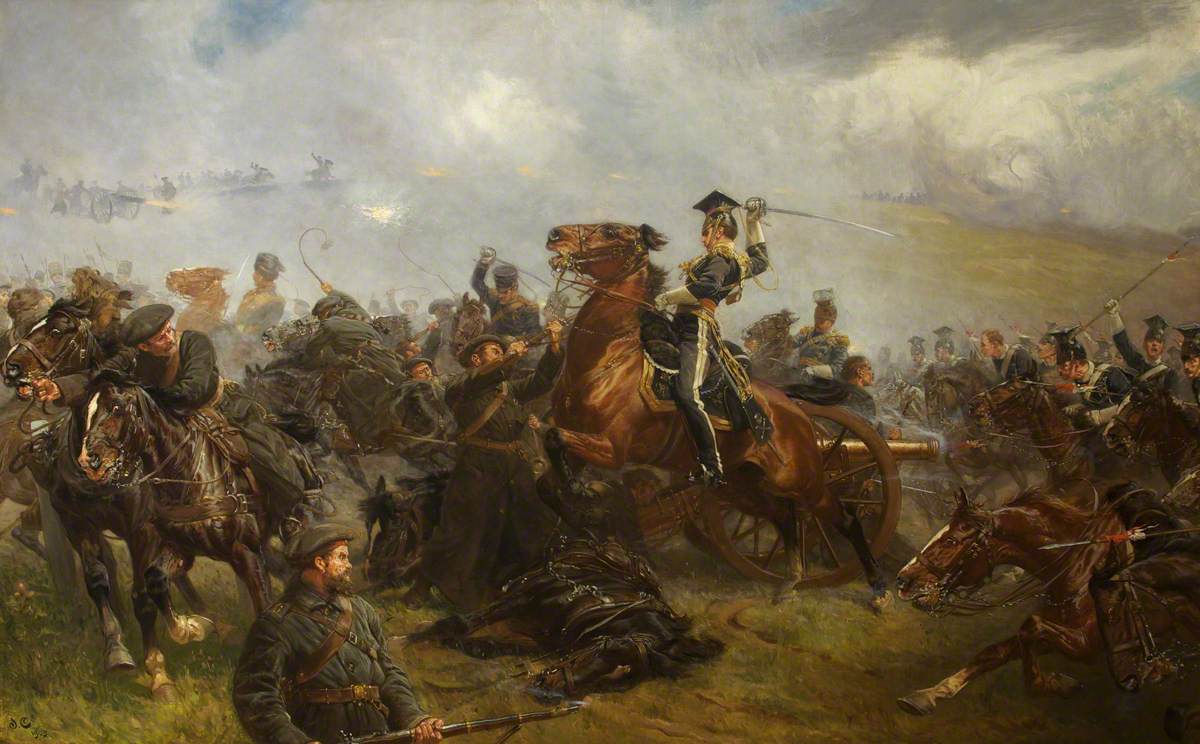
At approximately 11:10 in the morning, Lord Cardigan placed himself at the head of the Light Brigade, some 670 men mounted on light cavalry horses, and ordered the advance. They rode at a controlled trot, straight down the valley toward the Russian guns.
The Russians could not believe what they were seeing. Enemy fire erupted from three sides. Cannon balls tore through the ranks. Rifle fire poured down from the heights. Men and horses fell in heaps, but the survivors closed ranks and kept riding.
Captain Nolan was one of the first to die, killed by a shell fragment moments after the charge began. Whether he had realised the mistake and was trying to redirect the brigade remains one of history's unanswerable questions.
They Reached the Guns
Against all logic and probability, the Light Brigade reached the Russian battery. They sabred the gunners, scattered the support cavalry, and fought hand-to-hand among the cannons. For a brief, chaotic moment, they held the position.
But there was no support coming. The Heavy Brigade had not been ordered to follow. The Light Brigade, shattered and outnumbered, had no choice but to retreat back through the same murderous crossfire they had ridden into.
The Butcher's Bill
Of the roughly 670 men who charged, 110 were killed, 161 were wounded, and 375 horses were lost. The entire action lasted barely twenty minutes. It achieved nothing of military value.
A French general observing the charge famously remarked, "It is magnificent, but it is not war. It is madness." He was right on every count.
Glory From Disaster
The charge became famous almost immediately. Alfred, Lord Tennyson published his poem "The Charge of the Light Brigade" within weeks, transforming a catastrophic blunder into an immortal tale of courage and duty. "Theirs not to reason why, theirs but to do and die" became one of the most quoted lines in the English language.
The men of the Light Brigade deserved better than the orders they received. They were superb soldiers who obeyed without hesitation, even when every instinct told them they were riding to their deaths. Their courage was beyond question. The failure belonged entirely to their commanders.
The charge remains a powerful reminder that bravery alone cannot overcome bad leadership, and that the cost of incompetence in war is always paid in blood.
What are your thoughts on the Charge of the Light Brigade?