The Stakes Could Not Have Been Higher
By the autumn of 1805, Napoleon Bonaparte dominated Europe. His Grande Armee was massed on the French coast, ready to invade Britain. Only one thing stood in his way: the Royal Navy. If the combined French and Spanish fleets could gain control of the English Channel, even briefly, Napoleon's invasion barges would sail.
The man tasked with preventing this was Vice Admiral Horatio Nelson, already the most celebrated naval commander of his age. Small, slight, missing an arm and the sight in one eye from previous battles, Nelson was an unlikely warrior. But he possessed a tactical genius and a capacity to inspire devotion in his crews that no other officer could match.
The Chase Across the Atlantic
For months, Nelson had pursued the French fleet under Admiral Villeneuve across the Atlantic to the Caribbean and back. It was an exhausting game of cat and mouse, with Nelson always a step behind. Finally, in October 1805, Villeneuve's combined fleet of thirty-three ships took shelter in the Spanish port of Cadiz.
Nelson blockaded the port with twenty-seven ships of the line and waited. He knew that Villeneuve would eventually have to come out. When the enemy fleet finally sailed on 19 October, heading for the Mediterranean, Nelson gave chase immediately.
"England Expects"
On the morning of 21 October 1805, the two fleets sighted each other off Cape Trafalgar on the southern coast of Spain. Nelson's plan was revolutionary. Instead of the traditional parallel line of battle, he would attack in two columns, cutting the enemy line at right angles and creating a close-quarters brawl where British gunnery and seamanship would prove decisive.
As the British fleet bore down on the enemy, Nelson ordered his famous signal: "England expects that every man will do his duty." The message was greeted with cheers from ship to ship. Then the guns began to fire.
Into the Fury
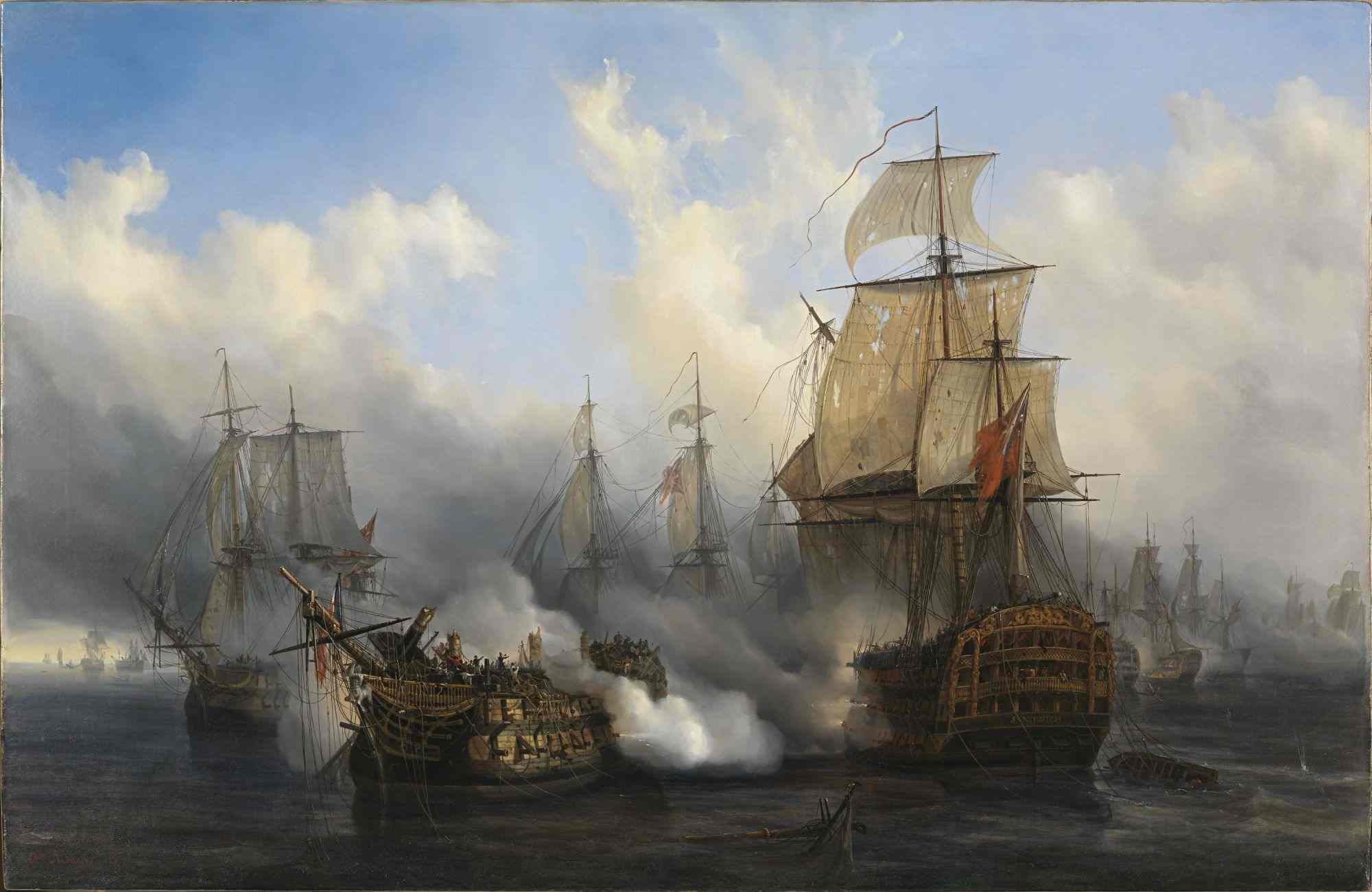
Nelson's flagship, HMS Victory, led the weather column straight into the heart of the enemy line. The approach was agonising. For nearly forty minutes, Victory endured raking fire without being able to reply, her decks swept with shot and splinter. Fifty men were killed or wounded before she fired a single gun.
When Victory finally broke through the line, she unleashed a devastating broadside into the stern of the French flagship Bucentaure, killing or wounding nearly 200 men with a single discharge. The battle dissolved into a savage melee of ship-to-ship combat, with vessels locked together and crews fighting at point-blank range.
The Death of Nelson
At approximately 1:15 in the afternoon, a French musketeer in the rigging of the Redoutable spotted Nelson on the quarterdeck of Victory, his medals and decorations making him an unmistakable target. The shot struck Nelson in the left shoulder, passed through his spine, and lodged beneath his right shoulder blade.
Nelson was carried below to the cockpit, where the surgeon could do nothing for him. He lived for another three hours, receiving reports of the battle's progress. When told that fifteen enemy ships had been captured, he whispered, "Thank God I have done my duty." He died at 4:30 that afternoon.
A Victory That Shaped the World
Trafalgar was a complete British triumph. Eighteen enemy ships were captured or destroyed. The Royal Navy did not lose a single vessel. The combined fleet was shattered beyond recovery, and Napoleon's invasion plans died on the waters off Cape Trafalgar.
The victory secured British naval supremacy for the next hundred years. It made possible the expansion of the British Empire, the protection of global trade routes, and the eventual defeat of Napoleon on land. Nelson became the greatest hero in British history, immortalised atop his column in Trafalgar Square.
His legacy endures not just in monuments and memorials, but in the principle he embodied: that courage, initiative, and willingness to sacrifice can change the course of history.
What does Nelson's legacy mean to you?