Forgotten Before the Fighting Stopped
They called themselves the Forgotten Army, and they were right. While the world's attention was fixed on D-Day and the advance through Europe, the British Fourteenth Army was fighting one of the most brutal campaigns of the Second World War in the jungles of Burma. The newspapers rarely mentioned them. Supplies were always last on the list. Even their families back home struggled to find Burma on a map.
Yet the Fourteenth Army fought and won what has been called the greatest land defeat ever inflicted on the Japanese military. Their story deserves to be told far more often than it is.
The Fall of Burma
Japan invaded Burma in January 1942, just weeks after the attack on Pearl Harbor. The British, Indian, and Burmese forces defending the colony were outnumbered, outflanked, and utterly unprepared for jungle warfare. Within months, the entire country was lost.
The retreat was catastrophic. Thousands of soldiers and civilians fled westward through mountains and malarial jungle toward India. Disease, starvation, and exhaustion killed more people than enemy action. It was the longest retreat in British military history, over 900 miles of misery.
Slim Takes Command
In late 1943, Lieutenant General William Slim was given command of the newly formed Fourteenth Army. Slim was that rarest of military leaders: a soldier's general. He had risen from the ranks, spoke several languages, and understood the ordinary soldier's experience in a way that many aristocratic British generals never could.
Slim transformed the Fourteenth Army from a demoralised, disease-ridden force into a formidable fighting machine. He insisted on proper malaria prevention, improved rations, ensured that Indian and African troops were treated with equal respect, and personally visited units across the vast front to build morale.
Imphal and Kohima
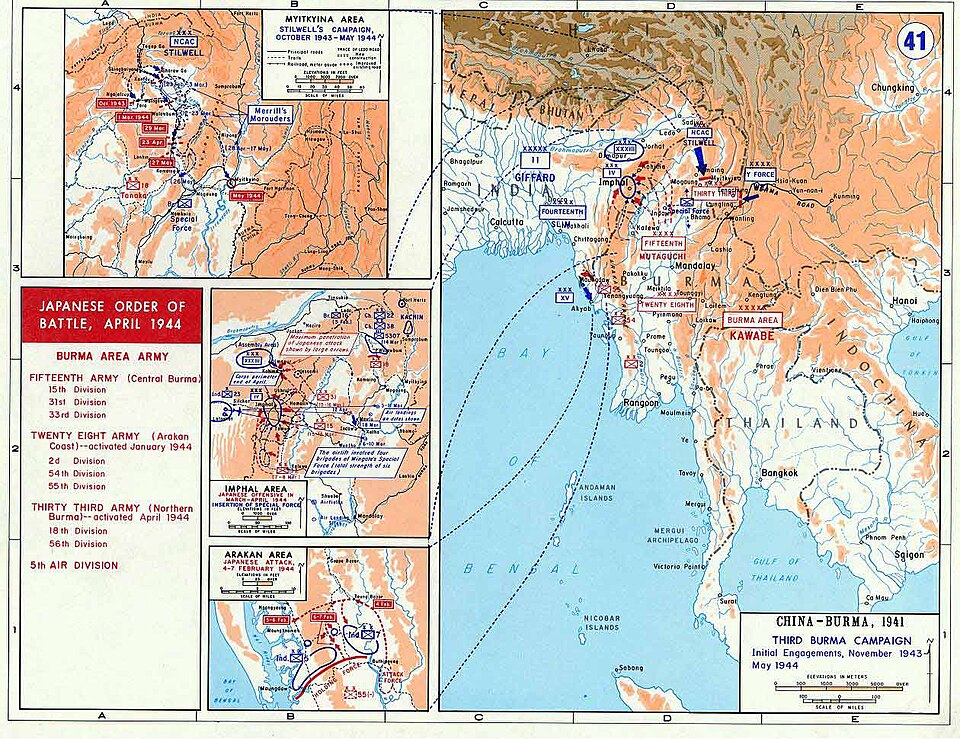
In March 1944, the Japanese launched Operation U-Go, a massive offensive aimed at invading India through the border towns of Imphal and Kohima. It was their most ambitious operation of the Burma campaign, involving over 85,000 troops.
At Kohima, a small garrison held out against overwhelming numbers in a battle so close that the opposing trenches were separated by the width of a tennis court. The fighting around the District Commissioner's tennis court became one of the most famous episodes of the war, with soldiers fighting hand-to-hand across the court for weeks.
At Imphal, Slim deliberately allowed the Japanese to surround his forces, then supplied them by air while methodically destroying the enemy's overextended supply lines. It was a bold gamble that paid off magnificently. The Japanese, starving and riddled with disease, were forced into a disastrous retreat.
Together, Imphal and Kohima cost the Japanese over 50,000 casualties. It was the turning point of the entire Burma campaign.
The Long March South
After Imphal, the Fourteenth Army pursued the shattered Japanese forces back into Burma. The advance was gruelling, across rivers, through jungle, and over mountains, often in monsoon conditions that turned every track into a river of mud.
Slim's masterstroke came at the crossing of the Irrawaddy River in early 1945. He feinted toward Mandalay while sending his main force in a wide flanking move to seize the vital supply hub at Meiktila. The Japanese were caught completely off guard. Mandalay fell on 20 March 1945, and Rangoon was liberated on 3 May.
The Fourteenth Army's Legacy
The Fourteenth Army was the most diverse force in British military history. It included British, Indian, Gurkha, African, and Burmese soldiers fighting side by side. Indian troops formed the largest contingent and bore a disproportionate share of the fighting and the casualties.
Slim himself remained modest about his achievements. After the war, he served as Governor-General of Australia but never sought the celebrity that other commanders enjoyed. His soldiers, however, never forgot him. To the men of the Forgotten Army, "Uncle Bill" was the finest general they ever served under.
If someone in your family served in Burma, their story matters.