An Invasion No One Expected
On 2 April 1982, Argentine forces invaded the Falkland Islands, a remote British territory in the South Atlantic with a population of fewer than 2,000 people. The small garrison of Royal Marines fought bravely but was overwhelmed within hours. The Argentine flag was raised over Stanley, and the world expected Britain to accept the fait accompli.
They were wrong. Within forty-eight hours, Prime Minister Margaret Thatcher had ordered the assembly of a naval task force to retake the islands by force. It was a decision that stunned diplomats, delighted the tabloid press, and terrified military planners who understood the enormous risks involved.
Sailing South
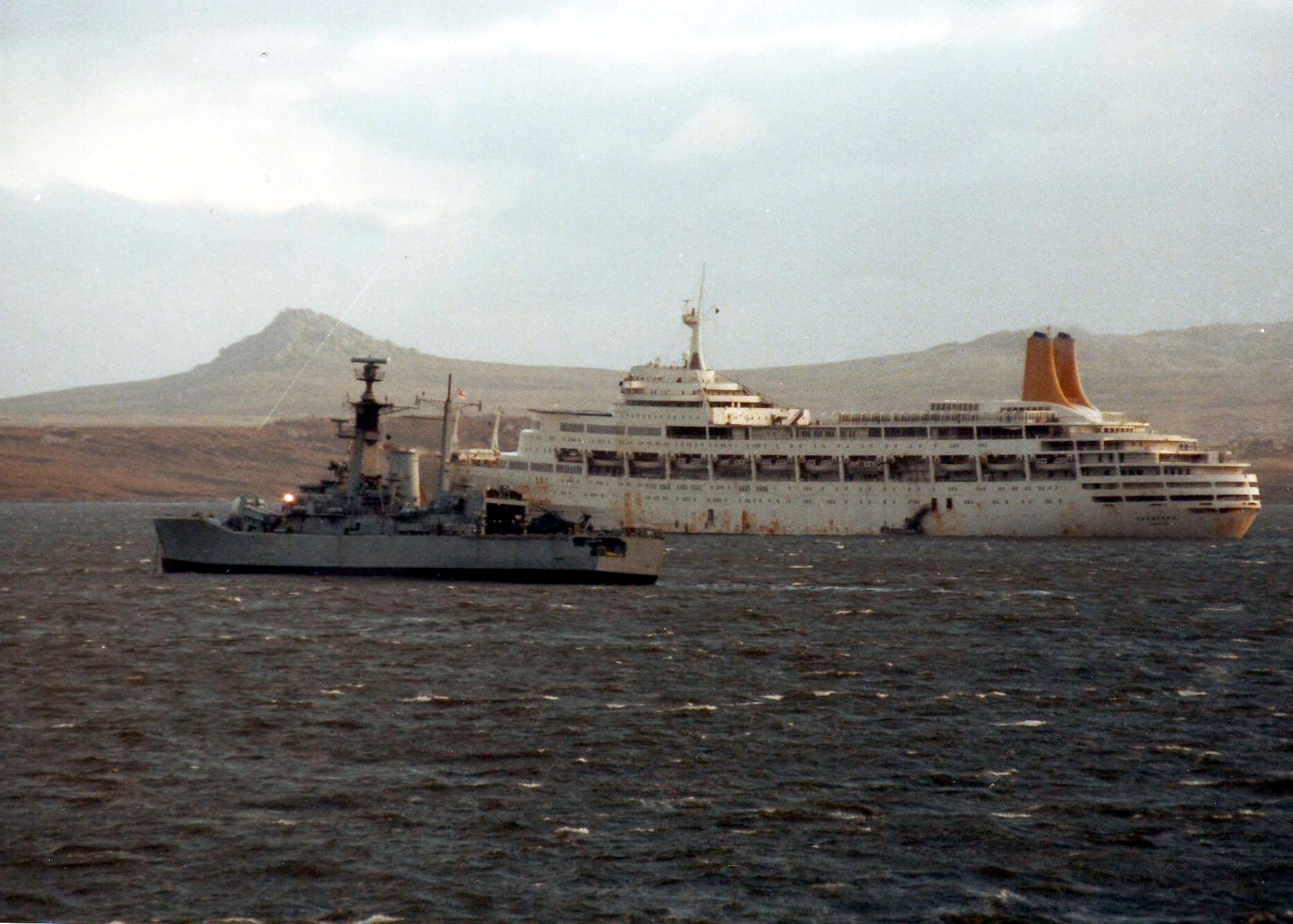
The task force sailed from Portsmouth on 5 April to scenes of extraordinary public emotion. Aircraft carriers, destroyers, frigates, and requisitioned civilian ships, including the luxury liners QE2 and Canberra, headed south on an 8,000-mile journey to the most remote battlefield imaginable.
The logistical challenges were staggering. There was no friendly port within 4,000 miles. Every round of ammunition, every gallon of fuel, and every bandage had to be carried with the fleet or delivered by ship from Ascension Island, the nearest British territory. The Americans provided crucial intelligence and use of Ascension, but officially remained neutral.
Sea and Air
The naval war was fought first. On 2 May, the submarine HMS Conqueror torpedoed the Argentine cruiser General Belgrano, killing 323 sailors. The sinking was controversial but effective, as the Argentine Navy returned to port and played no further part in the war.
Two days later, Argentina struck back. An Exocet missile fired from a Super Etendard aircraft hit the destroyer HMS Sheffield, killing twenty crew members and sending the ship to the bottom. It was the first British warship lost to enemy action since the Second World War, and it shocked the nation.
The air war continued throughout the campaign. Argentine pilots displayed extraordinary courage, flying at wave-top height to attack British ships in San Carlos Water, which the troops grimly nicknamed "Bomb Alley." HMS Ardent, Antelope, and Coventry were all sunk. The Atlantic Conveyor, carrying vital helicopters, was hit by an Exocet and destroyed.
The Land Battle
British forces landed at San Carlos on 21 May and began the advance on Stanley. With most of their heavy-lift helicopters lost on the Atlantic Conveyor, the Royal Marines and Paras had to cover much of the distance on foot, carrying enormous loads across trackless, boggy terrain in freezing conditions.
The battles for Goose Green, Mount Longdon, Tumbledown Mountain, and Wireless Ridge were fought at close quarters, often at night, with bayonets fixed. At Goose Green, Colonel "H" Jones of 2 Para was killed leading a charge against an Argentine trench and was posthumously awarded the Victoria Cross.
The fighting was fierce, but the Argentine conscripts, many of them poorly trained teenagers from tropical provinces, were cold, hungry, and demoralised. On 14 June, the Argentine garrison in Stanley surrendered. The war was over.
The Cost
Britain lost 255 killed and 775 wounded. Argentina suffered 649 killed, 1,657 wounded, and nearly 12,000 taken prisoner. Six British ships were sunk and many more damaged. The human cost was heavy on both sides, and the scars, physical and psychological, lasted far longer than the seventy-four-day conflict.
What It Meant
The Falklands War transformed British politics and national confidence. Thatcher's government, deeply unpopular before the war, won a landslide election the following year. The military proved it could still project power across the globe. In Argentina, the defeat hastened the fall of the military junta and the return of democracy.
For the people of the Falkland Islands, the war confirmed their wish to remain British, a desire they have reaffirmed in every referendum since. For the veterans, the war left memories that time has softened but never erased.
These first-hand accounts are among the most valuable records we have.