The Quiz Question
At which Pennsylvania encampment did George Washington's Continental Army endure a brutal winter in 1777-1778 while Prussian officer Baron von Steuben drilled the troops into a disciplined fighting force?
- A. Valley Forge
- B. Morristown
- C. White Plains
- D. Fort Ticonderoga
The answer is A. Valley Forge. Here is the full story.
In December 1777, George Washington led roughly 12,000 men into a frozen Pennsylvania valley and asked them to endure the impossible. What followed over the next six months was not a battle — it was a crucible. The men who staggered out of Valley Forge in the spring of 1778 were a different army from the one that had limped in. That transformation had a name: Baron Friedrich von Steuben.
A Winter That Could Have Ended America
The Continental Army arrived at Valley Forge on 19 December 1777. Soldiers left bloody footprints in the snow — many had no shoes, wrapping their feet in rags or strips of blanket. The temperature would drop as low as -10°F before the winter was out.
Valley Forge sits just 18 miles northwest of Philadelphia. That proximity was both strategic and humiliating: while Washington's men shivered in crude huts, British officers under General William Howe dined comfortably in the city's drawing rooms, attended concerts, and staged theatrical performances. The contrast could not have been more stark.
Washington wrote to Congress in language stripped of his usual diplomatic restraint: "Unless some great and capital change suddenly takes place… this Army must inevitably… Starve, dissolve, or disperse." It was not an exaggeration. Valley Forge was the Revolution's lowest point — and its potential turning point, all at once.
Why Valley Forge? The Strategic Context of 1777
The autumn of 1777 had been a catalogue of defeat. The Continental Army was routed at the Battle of Brandywine on 11 September and repulsed again at Germantown on 4 October. Philadelphia — the young nation's capital — fell to the British as a direct consequence.
Washington chose Valley Forge with cold-eyed logic. The high ground between the Schuylkill River and Valley Creek offered a naturally defensible position, allowing him to monitor British movements while keeping his army concentrated. Dispersing troops into scattered winter quarters, as European armies typically did, would have destroyed unit cohesion and left the countryside unprotected.
Congress, now relocated to York, Pennsylvania, was pressing Washington to resume offensive operations — pressure he firmly and correctly resisted. Adding to the strain, a political faction within Congress and the officer corps was quietly exploring whether Washington should be replaced. This intrigue, known as the Conway Cabal after one of its participants, Brigadier General Thomas Conway, ultimately came to nothing — but it was a real distraction during the army's darkest weeks.
The Agony of the Encampment: Hunger, Cold and Disease
Washington organised the construction of roughly 2,000 log huts to shelter his men — he even offered a $12 prize for the most efficient design, a small incentive that helped speed the work. The huts were completed by late December 1777, but they offered only partial relief from the cold.
By February 1778, the army's commissary system had effectively collapsed. Regiments went days without food, surviving on what the soldiers called "firecake" — a grim paste of flour and water baked directly on hot stones. Approximately 2,000 horses died of starvation during the encampment, crippling the army's artillery and supply transport at the worst possible moment.
Disease was the real killer. Typhus, typhoid, dysentery and pneumonia swept through the overcrowded huts. Historians estimate that between 2,000 and 2,500 men died at Valley Forge — far more than in any single engagement of the 1777 campaign. Soldiers lacked blankets, coats and shoes. The Quartermaster General, Thomas Mifflin, had allowed the supply chain to collapse through a combination of incompetence and corruption.
Washington the Leader: Holding the Army Together
Washington made his headquarters at the stone Potts House, but he refused to take comfortable quarters removed from his men. He was a constant presence in the camp — inspecting huts, visiting the sick, walking the lines. That visibility mattered enormously to men on the edge of desertion.
Between December 1777 and February 1778, Washington wrote over 100 letters to Congress and state governors, pleading for food, clothing, money and reinforcements. In March 1778 he acted decisively on the supply problem, replacing the failed Mifflin as Quartermaster General with Nathanael Greene — one of his most trusted and capable officers. Greene's organisational skill began to restore the broken logistics chain almost immediately.
Martha Washington arrived at Valley Forge in February 1778, nursing the sick and maintaining the social fabric of the officer community. Other officers' wives followed her example. Her presence was a quiet but powerful statement: the Washingtons were not abandoning their army.
Enter Baron von Steuben: The Man Who Drilled an Army
Friedrich Wilhelm August Heinrich Ferdinand von Steuben rode into Valley Forge on 23 February 1778, introduced through Benjamin Franklin's connections in Paris. He was a former staff officer who had served under Frederick the Great in the Prussian Army — one of the most professionally drilled military forces in the world. He had somewhat inflated his rank and title to secure his passage to America, presenting himself as a lieutenant general rather than a captain. Washington knew, and didn't much care: what mattered was what the man could do.
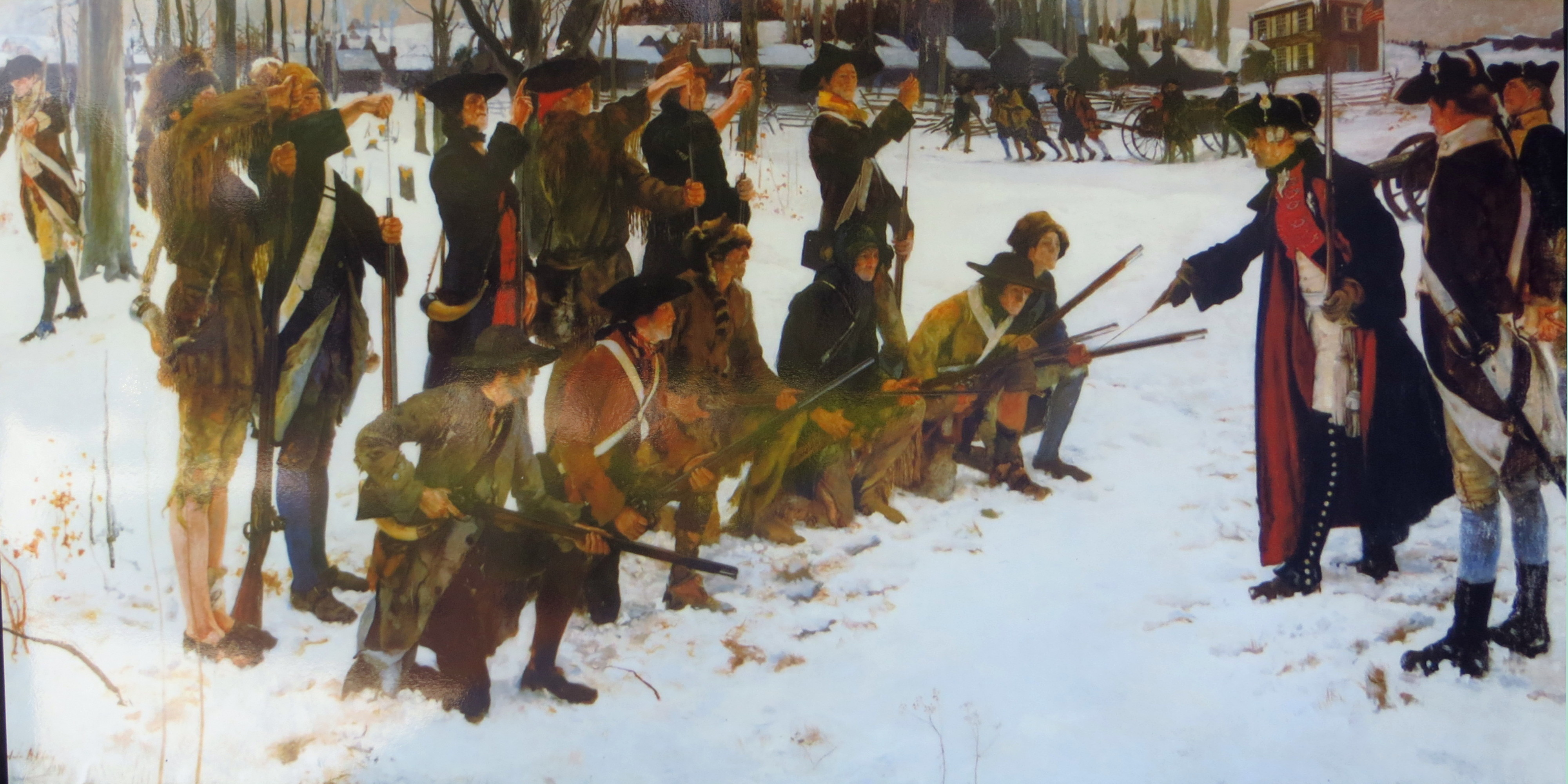
Von Steuben immediately did something that would have been unthinkable for a European officer of his claimed rank: he went directly onto the parade ground and drilled the men himself. He selected a model company of 100 soldiers and worked with them personally, day after day, demonstrating every movement rather than leaving instruction to subordinates.
His personality was as important as his methods. When frustrated by the soldiers' errors, he would curse colourfully in German and French, then burst out laughing at his own inability to find the English words — and the men laughed with him. He worked with his translator Pierre Duponceau to produce a training manual in French, which was rendered into English and distributed across the army. It was a remarkable act of cross-cultural military improvisation.
The Transformation: From Mob to Military Machine
Von Steuben standardised the musket loading drill to 15 clearly defined steps, allowing soldiers to reload faster and more reliably under the chaos of combat. He introduced consistent marching formations and coordinated turning movements — the basic building blocks of 18th-century battlefield manoeuvre that the Continental Army had never properly mastered.
Perhaps most importantly, he taught bayonet drill. American soldiers had largely been using their bayonets as cooking tools rather than weapons. Von Steuben turned the bayonet into an offensive instrument — and at the Battle of Stony Point in July 1779, Anthony Wayne's troops would prove exactly how lethal that lesson had become.
His cascade training method was ingenious. The model company became a body of instructors who fanned out across the army's brigades, each man training others in turn. Within weeks, new standards were spreading rapidly through all units. By April 1778, Washington had soldiers who could manoeuvre in formation, respond to commands under fire, and hold a line rather than dissolve into individual skirmishing.
On 5 May 1778, von Steuben was officially appointed Inspector General of the Continental Army with the rank of Major General. He held the position — and continued drilling, inspecting and reforming — for the remainder of the war.
Spring 1778: France Enters the War and the Army Marches Out
News reached Valley Forge in May 1778 that France had formally allied with the United States. The Treaty of Amity and Commerce, signed on 6 February 1778, transformed the strategic picture overnight. Britain now faced a global war, with French naval power threatening its supply lines and colonial possessions far beyond North America.
The British evacuated Philadelphia on 18 June 1778, marching overland toward New York. Washington immediately ordered pursuit. On 28 June 1778, the Continental Army engaged the British rearguard at the Battle of Monmouth, New Jersey, in temperatures pushing 100°F.
What happened at Monmouth was the proof of Valley Forge. Continental soldiers stood in the open and traded disciplined volleys with British regulars — the kind of sustained, coordinated fire that had been impossible at Brandywine. When a premature retreat by General Charles Lee threatened to unravel the engagement, Washington rallied his men personally and stabilised the line. European observers noted with undisguised astonishment that this was no longer a militia. It was an army.
The Human Stories: Faces in the Snow
Private Joseph Plumb Martin of Connecticut kept a diary throughout the war. His accounts of Valley Forge — eating boiled tree bark, surviving on scraps, watching comrades die — became the most vivid eyewitness record of the encampment and are still widely quoted by historians today.
General Anthony Wayne of Pennsylvania worked relentlessly to requisition food from surrounding farms — sometimes by force — to keep his men alive. Surgeon Albigence Waldo of Connecticut documented the medical catastrophe in clinical, harrowing detail, describing men "without a shoe or shirt" packed into huts thick with disease.
In February 1778, warriors of the Oneida Nation — allies of the Americans — arrived at Valley Forge carrying supplies of corn. It was an act of solidarity that mattered beyond the food itself; it told the starving men that they had not been forgotten by the world outside the camp.
Many of the soldiers who chose to stay through the worst of it were recent immigrants — Irish, German, Polish men who had come to America with nothing and understood, in the most concrete possible terms, what they were fighting for. Their endurance is inseparable from the story of what Valley Forge produced.
Legacy: Why Valley Forge Still Matters
Valley Forge entered American memory almost immediately as the defining test of national character — a story of suffering transformed into strength. Every generation of US soldiers from the Civil War onward has been taught its lessons, formally or informally. Washington's refusal to abandon his army, and his army's refusal to abandon the cause, became the foundational myth of American military endurance.
Von Steuben's Regulations for the Order and Discipline of the Troops of the United States, published in 1779, remained the official drill manual of the US Army until 1814. It was a practical document that shaped the institution for more than three decades after the war it was written to win.
The encampment site is now Valley Forge National Historical Park, covering approximately 3,500 acres and attracting over 1.5 million visitors each year. Walking the reconstructed hut lines, it is still possible to feel the scale of what was endured there — and what was built there.
Historians continue to debate the precise death toll. Modern estimates from the National Park Service range from 1,700 to 2,500, placing Valley Forge among the deadliest episodes of the entire war — without a single pitched engagement. The suffering was real, the loss was immense, and the outcome was improbable.
That is the deepest lesson of Valley Forge: that wars are not won only by courage in battle, but by the patient, unglamorous work of building institutions that can endure when everything goes wrong. Von Steuben understood that. Washington understood it. The men who left bloody footprints in December snow and marched out in June sunshine had proved it.
If this story moved you, share it with someone who loves American history — and tell us in the comments: which figure from Valley Forge do you find most remarkable, and why?
Further Reading
- Valley Forge National Historical Park (National Park Service, USA)
- The Library of Congress — American Revolution collections
- The American Philosophical Society, Philadelphia — von Steuben papers
- The Smithsonian National Museum of American History, Washington D.C.
- The Historical Society of Pennsylvania, Philadelphia