The Quiz Question
At which December 1862 battle did Union troops under Burnside suffer heavy losses charging entrenched Confederates on Marye's Heights?
- A. Battle of Fredericksburg
- B. Battle of Chancellorsville
- C. Battle of the Wilderness
- D. Battle of Spotsylvania
The answer is A. Battle of Fredericksburg. Here is the full story.
On 13 December 1862, the Army of the Potomac walked into one of the worst disasters in American military history. By the time darkness fell over Fredericksburg, Virginia, more than 12,600 Union soldiers had been killed, wounded, or gone missing — most of them cut down crossing a few hundred yards of open ground that Confederate defenders had turned into a perfect killing field. It was a day that shook the Northern public, nearly broke Abraham Lincoln, and cast a long shadow over the remaining years of the Civil War.
A Day the Union Would Never Forget: 13 December 1862
General Ambrose Burnside ordered fourteen separate frontal assaults against the Confederate position at Marye's Heights that day. Every single one failed. Confederate General James Longstreet reportedly said his men could hold their ground if every soldier had a thousand bullets — in the event, they hardly needed that many.
Eyewitnesses described the slopes of Marye's Heights as carpeted with Union dead, a sight that haunted survivors for the rest of their lives. The battle shocked the Northern public and deepened a crisis of confidence in President Lincoln's war leadership at the very moment he was preparing to issue the Emancipation Proclamation. Fredericksburg was not just a military defeat — it was a political earthquake.
The Road to Fredericksburg: How the Union Ended Up Here
The roots of the disaster stretched back to the bloody stalemate at Antietam in September 1862. Frustrated by General George McClellan's persistent caution in pursuing Lee's retreating army, Lincoln replaced him with Burnside in November 1862. It was a decision both men had reason to regret.
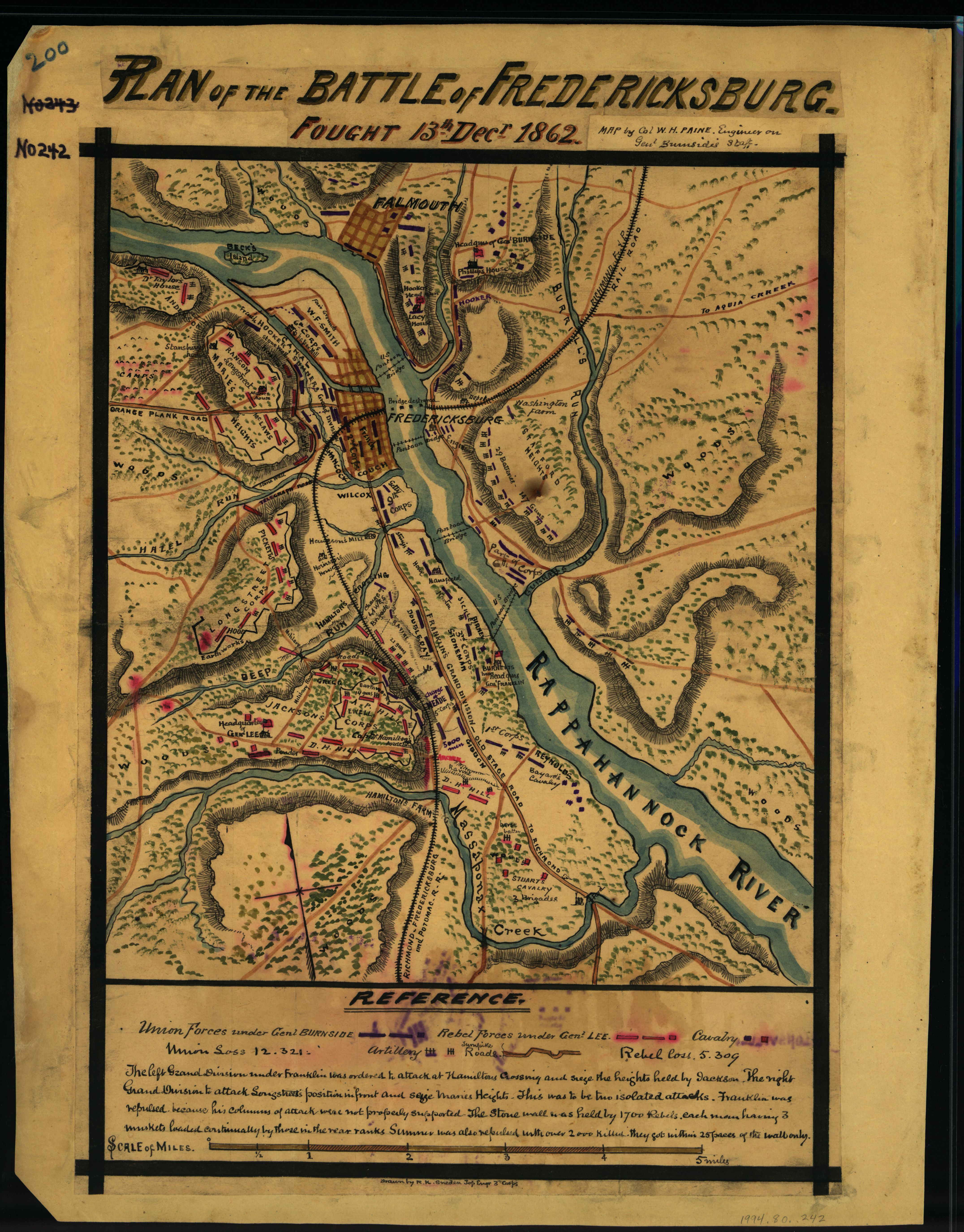
Burnside proposed a bold plan: march rapidly south to Fredericksburg, Virginia, cross the Rappahannock River, and drive directly on the Confederate capital at Richmond. Speed was everything. The plan hinged entirely on pontoon bridging equipment arriving on time — and it didn't. The pontoons arrived weeks late, handing Robert E. Lee precious time to fortify the heights south of the river.
Fredericksburg itself, a town of around 5,000 people, sat on the south bank of the Rappahannock. By early December 1862, Lee had approximately 78,500 troops entrenched in a commanding defensive arc stretching nearly seven miles across the high ground behind the town. The delayed pontoons had transformed a potentially decisive manoeuvre into a frontal assault against one of the strongest natural defensive positions in the eastern theatre.
The Men Behind the Battle: Burnside, Lee, and Longstreet
Ambrose Burnside was 38 years old and genuinely popular with his men — a warm, physically distinctive officer with the famous side-whiskers that gave the English language the word "sideburns." But he was also a self-doubting commander who had twice previously refused the command of the Army of the Potomac, knowing his own limitations. He accepted it the third time only because he feared a less capable rival would get the job instead.
Robert E. Lee, 55, had selected Fredericksburg's heights with a professional eye. The ground offered clear fields of fire across open terrain, commanding artillery positions, and a river obstacle to slow any Union advance. It was, in Lee's assessment, close to an ideal defensive position. General James Longstreet — Lee's "Old War Horse" — commanded the Confederate First Corps holding Marye's Heights and the sunken road below it.
Union General Edwin Sumner commanded the Right Grand Division, the force tasked with the frontal assault on Marye's Heights. Behind the stone wall at the base of the heights stood Confederate troops under Brigadier General Thomas Cobb, a former Georgia politician turned soldier. Cobb would be mortally wounded before the day was done — one of the Confederate army's few significant losses in the battle.
Crossing the River: Union Engineers Under Fire
The battle effectively began on 11 December, two days before the main assault. Union engineers attempted to lay pontoon bridges across the Rappahannock, only to find themselves under withering fire from Confederate sharpshooters of Barksdale's Mississippi Brigade. Around 1,600 riflemen from William Barksdale's command had taken up positions inside Fredericksburg's buildings, pinning down the bridge-builders for hours in one of the first large-scale urban combat actions of the entire war.
Burnside responded by ordering 147 artillery pieces to open a massive bombardment of Fredericksburg — one of the heaviest Union artillery barrages of the war to that point. The town suffered serious damage, but the sharpshooters survived among the rubble. Union troops eventually solved the problem by crossing the river in the pontoon boats themselves, conducting an opposed river assault and then clearing the town house by house in brutal close-quarters fighting.
By the evening of 11 December, Union forces held Fredericksburg. Soldiers spent parts of 12 December looting the abandoned town — an episode that troubled many officers. On the morning of 13 December, the real test began.
The Stone Wall and the Sunken Road: A Perfect Killing Ground
At the base of Marye's Heights ran a sunken road — slightly lower than the surrounding ground — bordered on its town-facing side by a stone wall standing roughly four feet high. Confederate infantry stood four ranks deep behind it, rotating forward to fire and stepping back to reload, maintaining near-continuous volleys. Longstreet had estimated before the battle that no Union soldier could survive the 400-yard crossing of open ground between the town's edge and the wall.
Confederate artillery under Colonel Edward Porter Alexander was positioned on the heights above, able to pour enfilading fire down across the entire approach. The ground sloped gently upward toward the wall, offering virtually no natural cover. About halfway across the killing ground, a drainage ditch became a desperate refuge for wounded Union soldiers who crawled into it, unable to advance or retreat.
Wave After Wave: The Assaults on Marye's Heights
The first Union assault, led by Brigadier General William French's division, stepped off at approximately 12:30 pm. French's men were cut down in swaths before they could close within 100 yards of the stone wall. Not a single Union soldier reached the wall that day — that stark fact tells the whole story of the afternoon.
General Winfield Scott Hancock's division followed French's, suffering over 2,000 casualties in a matter of minutes. Hancock himself later described the field as "a great slaughter pen." Yet Burnside kept ordering assaults. Throughout the long afternoon, fourteen separate brigade-level attacks were launched against the same stretch of stone wall, each one broken apart in the same way, in the same ground, with the same result.
By nightfall, the slopes of Marye's Heights were strewn with Union dead and wounded. Survivors pressed themselves flat against the frozen earth, unable to retreat without drawing Confederate fire. The temperature was dropping fast.
A Night of Horrors: Aftermath on the Battlefield
Temperatures fell below freezing on the night of 13 December. Thousands of wounded Union soldiers lay exposed on the open hillside, beyond the reach of stretcher-bearers. The cries of the wounded carried clearly to Confederate positions on the heights above — a sound that deeply affected men on both sides.
That same night, the Aurora Borealis — the Northern Lights — appeared with unusual brilliance over the battlefield. Many soldiers on both sides recorded the sight in letters and diaries, interpreting it as an omen. The surreal beauty above the frozen horror below made the night feel, to many witnesses, almost biblical.
On 14 December, Confederate Sergeant Richard Kirkland of the 2nd South Carolina Infantry reportedly risked his own life to carry water to wounded Union soldiers lying on the hillside. Later generations called him "the Angel of Marye's Heights," and a monument to him stands at the battlefield today. When Burnside met with his corps commanders that night, he proposed personally leading one final assault the following morning. His generals talked him out of it.
Union losses totalled approximately 12,653 killed, wounded, or missing. Confederate losses were around 5,377 — significant, but far lower than an army fighting from prepared positions might have expected against such persistent attack.
The Political Earthquake: Lincoln, the Army, and a Nation in Crisis
News of the disaster reached Washington within days. Lincoln reportedly said, "If there is a worse place than Hell, I am in it," upon learning the full extent of the casualty figures. Morale in the Army of the Potomac collapsed over the weeks that followed, with desertion rates rising sharply through January 1863 — contemporary records suggest the army was losing men at an alarming daily rate.
The political consequences were immediate and severe. Republican senators launched a Cabinet crisis in mid-December, attempting to force Lincoln to dismiss Secretary of State William Seward — a power play directly energised by the public fury over Fredericksburg. Lincoln managed the crisis with considerable political skill, but it cost him time and energy he could ill afford.
Burnside attempted one more offensive in January 1863 — the infamous "Mud March" — which bogged down hopelessly in winter rains and finished his credibility entirely. Lincoln replaced him with General Joseph Hooker on 26 January 1863. Meanwhile, the defeat strengthened the Northern "Copperheads" — Democrats who opposed the war outright — and made the Emancipation Proclamation, issued just weeks after the battle on 1 January 1863, a politically fraught document that Fredericksburg's shadow made harder to celebrate.
Legacy: Why Fredericksburg Still Matters
Fredericksburg became one of the defining symbols of the futility of frontal assault against prepared defences. The tactical lesson — that determined defenders behind cover could destroy attacking infantry in the open — had to be relearned tragically in the trenches of the Western Front fifty years later, at hideous cost. The battle sits at a dark junction between older ideas of battlefield courage and the modern reality of industrial warfare.
Photographer Mathew Brady and his team documented the aftermath of Civil War battles, bringing the reality of mass casualties into Northern living rooms in an era before broadcast media. Images of the dead changed how the Northern public perceived the war — Fredericksburg was part of that brutal education.
For the Confederacy, Fredericksburg was one of Lee's most complete defensive victories. But it solved nothing strategically. The Union rebuilt, reorganised, and kept fighting. The Army of the Potomac would return to the Fredericksburg area again in 1863 at Chancellorsville and in 1864 during Grant's Overland Campaign — the ground around the Rappahannock was soaked in blood before the war was over.
The battle site is preserved today as Fredericksburg and Spotsylvania National Military Park, managed by the National Park Service. The stone wall and sunken road can still be walked by visitors, the ground largely unchanged from the December afternoon when thousands of men died crossing it.
Perhaps what lingers most powerfully is the image of the ordinary Union soldiers themselves — men who stepped out into the open knowing, after the first few waves, almost certainly what awaited them, and who kept going anyway. Wave after wave, regiment after regiment, they marched forward into a storm of fire. It is one of the most haunting examples of military discipline, obedience, and raw human courage in American history — and one of its greatest tragedies.
If this story moved you, we'd love to hear your thoughts in the comments below. Share this article with a fellow history lover who deserves to know what happened on that frozen December hillside.
Further Reading
- Fredericksburg and Spotsylvania National Military Park — National Park Service
- Library of Congress — Civil War Collections
- Smithsonian National Museum of American History
- American Battlefield Trust
- Museum of the Confederacy (American Civil War Museum), Richmond, Virginia