The Quiz Question
On August 19, 1812, which U.S. frigate earned the nickname 'Old Ironsides' after British cannonballs bounced off its oak hull during a battle with HMS Guerriere?
- A. USS Constitution
- B. USS United States
- C. USS President
- D. USS Congress
The answer is A. USS Constitution. Here is the full story.
The Shot That Bounced Round the World
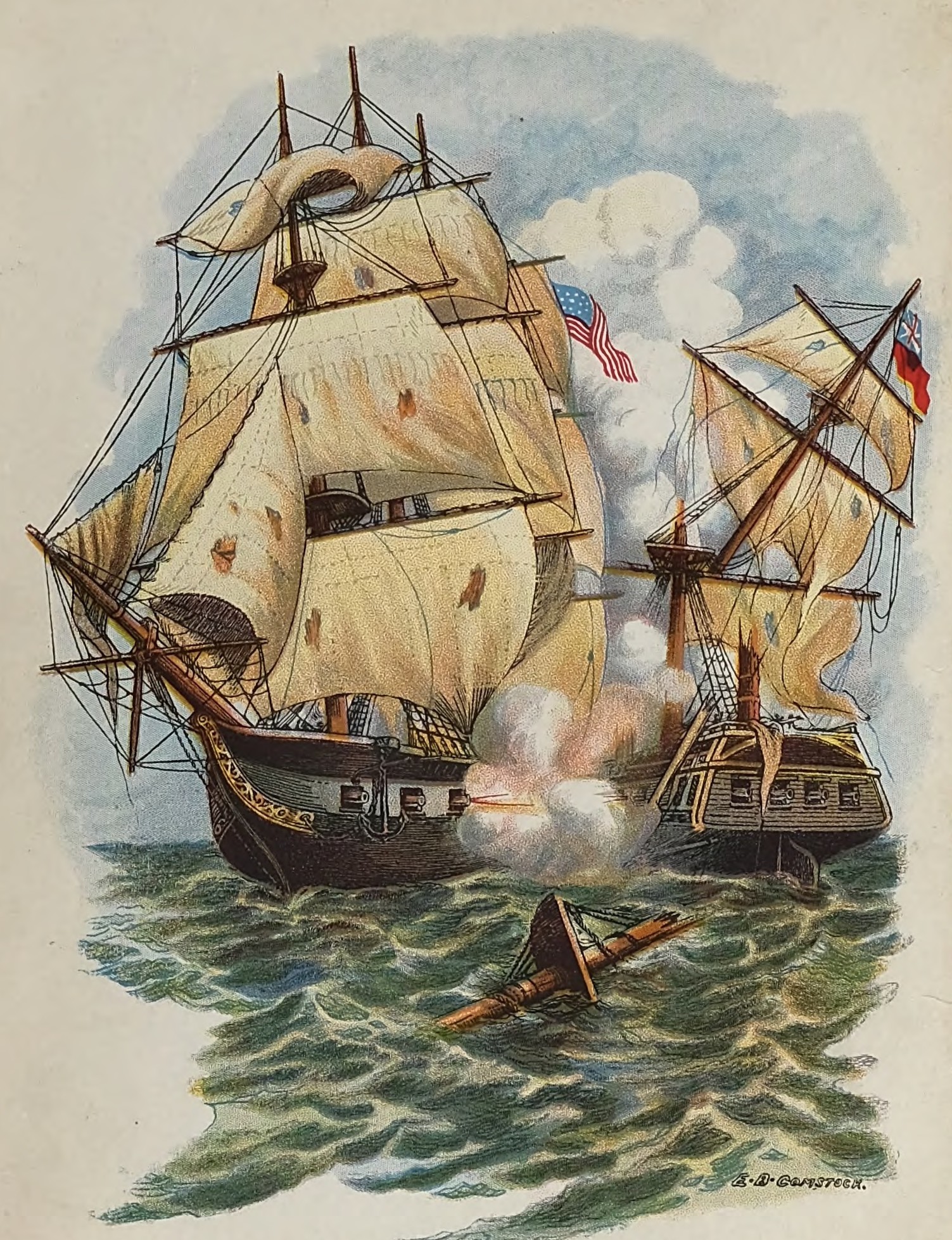
On 19 August 1812, somewhere in the North Atlantic roughly 400 miles southeast of Halifax, Nova Scotia, a British cannonball struck the hull of USS Constitution — and simply fell into the sea.
An American sailor, watching in disbelief, reportedly cried out: 'Her sides are made of iron!' — and a legend was born on the spot.
The nickname 'Old Ironsides' has endured for over 200 years, and USS Constitution still floats today as the world's oldest commissioned naval warship still afloat. That single battle lasted less than 35 minutes, yet its impact on American identity, British naval pride, and the course of the War of 1812 stretched for years.
To understand why this clash mattered so deeply, we need to go back to the ship herself — her design, her purpose, and the extraordinary circumstances that put her on a collision course with HMS Guerriere.
Why America Built a Ship Like USS Constitution
USS Constitution was launched on 21 October 1797 in Boston, Massachusetts, one of six heavy frigates authorised by the Naval Act of 1794 — Congress's answer to Barbary pirates threatening American merchant shipping in the Mediterranean.
She was designed by naval architect Joshua Humphreys, who had a bold and unconventional vision: build frigates heavier and faster than any comparable European ship, capable of outrunning ships of the line and outgunning any frigate afloat. It was an audacious brief, and Humphreys delivered.
Her hull was constructed from up to 1,500 loads of live oak — a species so dense it was nearly 40% harder than regular oak — harvested from the Sea Islands of Georgia and South Carolina. The timber was sourced, shaped, and fitted with extraordinary care, giving Constitution a structural integrity that would prove decisive in battle.
At 204 feet long and displacing around 2,200 tons, she carried 44 guns (often more in practice), making her significantly more powerful than a standard British 38-gun frigate. By 1812, the United States had fewer than 20 warships; Britain's Royal Navy boasted over 600. The Americans knew they could not match Britain at sea — they needed individual ships that could punch far above their weight, and Constitution was the finest example of that philosophy.
The War of 1812: Why Britain and America Went to War
War was declared by the United States on 18 June 1812, driven largely by British interference with American shipping during the Napoleonic Wars and the hated practice of impressment — Royal Navy officers boarding American vessels and forcibly pressing sailors into British service, regardless of their citizenship.
Britain, locked in its existential struggle with Napoleon Bonaparte, viewed the American declaration as a dangerous distraction at best and a betrayal at worst. Most senior British naval officers dismissed the US Navy with open contempt.
HMS Guerriere had actually been sailing provocatively off the American coast in the months before war was declared. She had gone so far as to impress sailors from the American brig Spitfire in May 1811 — an act of arrogance that enraged American public opinion and made her a particular target of American anger when hostilities began.
When war came, the Royal Navy expected quick, easy victories at sea. The idea that any American frigate could seriously threaten a British warship was, to most British officers, simply laughable. They were about to be educated otherwise.
The Two Captains: Hull and Dacres
Captain Isaac Hull, 39 years old in 1812, was a Connecticut-born mariner who had been at sea since the age of 14. He had commanded Constitution since 1810 and knew her capabilities with the intimate confidence of a man who had lived aboard her through all weather and all moods.
Hull was bold, resourceful, and cool under pressure. Just weeks before the battle with Guerriere, he had executed a brilliant 57-hour escape from a British squadron of five ships off the New Jersey coast, using kedge anchors dropped ahead of the ship and teams of men rowing in small boats to haul her through dead-calm water. It was a feat of seamanship that left his pursuers astonished and his crew brimming with confidence.
Captain James Richard Dacres, commanding HMS Guerriere, was just 26 years old — aristocratic, self-assured, and steeped in the Royal Navy's culture of assumed superiority. He had reportedly told American officers he could take any American frigate within 30 minutes. He had even nailed a sign to Guerriere's mast reading 'Not the Little Belt' — a gloating reference to an earlier incident involving a small British sloop — effectively daring any American ship to come and fight him.
The contrast between the two men was stark: Hull was a proven professional with a point to prove; Dacres was a young captain who had perhaps begun to believe his own navy's propaganda about American weakness. On 19 August 1812, reality arrived with considerable force.
The Battle: 35 Minutes That Changed Everything
At approximately 2:00 PM on 19 August 1812, Constitution and Guerriere sighted each other in moderate seas. Dacres cleared for action and waited confidently; Hull manoeuvred with patience, holding his fire at a disciplined distance even as Guerriere opened up with ranging shots.
Hull famously paced the deck urging his crew to hold fire until the ships were at point-blank range — reportedly splitting his trousers in the tension of the moment — before finally shouting the order to open fire. Constitution's first devastating broadside killed or wounded dozens of Guerriere's crew in a single terrible minute.
The heavier American guns — many long 24-pounders — combined with the sheer thickness of Constitution's oak hull gave her a crushing advantage in the exchange. Guerriere's 18-pound shot struggled to penetrate; Constitution's replies did not. Within 25 minutes, Guerriere's mizzen mast had fallen, dragging in the water and causing her to steer erratically. Her fore and main masts followed soon after, leaving her a helpless, wallowing wreck.
Guerriere had fired over 70 shots at Constitution during the engagement; Hull's ship suffered only 7 killed and 7 wounded. Dacres struck his colours — the naval signal of surrender — at approximately 3:00 PM. Guerriere was so badly damaged she could not be sailed as a prize; Constitution's crew transferred the survivors, and the shattered hulk was burned on 20 August 1812. Those watching from Constitution's deck saw her magazine explode and the remnants slide beneath the Atlantic.
Why the Cannonballs Really Did 'Bounce Off'
The legend of cannonballs bouncing off Constitution's sides is not pure myth — there is genuine science behind it, rooted in her extraordinary construction. Live oak (Quercus virginiana) is one of the densest hardwoods in North America, and Constitution's hull planking reached up to 21 inches thick in places, combining live oak, white oak, and red cedar in multiple reinforcing layers.
At longer ranges, British 18-pound shot — the standard for Guerriere's main armament — genuinely could fail to penetrate this layered hull, particularly when striking at an oblique angle. The combination of wood density, thickness, and the curving geometry of the hull deflected shot that would have smashed through a conventionally built frigate.
By contrast, Constitution's 24-pound long guns fired heavier shot with greater force. At close quarters her carronades — large-bore, short-range weapons capable of devastating destruction — were brought to bear with terrible effect. Naval historians who have analysed the engagement confirm that Constitution's design gave her a legitimate and significant defensive advantage, though the 'bouncing' effect was most pronounced at range. Up close, any wooden warship was vulnerable to concentrated fire — which is precisely why Hull closed the distance before unleashing his broadsides.
The Aftermath: Shock, Celebration, and Consequences
When Hull sailed into Boston on 30 August 1812 with news of the victory, the city erupted. Church bells rang, crowds flooded the streets, and newspapers proclaimed the triumph across the young nation. After a summer in which American land forces had suffered embarrassing reverses — Detroit had just fallen to British and Indigenous forces under Major General Isaac Brock — the country desperately needed a reason to cheer.
In Britain, the reaction was stunned disbelief. The Times of London called the outcome 'mortifying,' struggling to explain how a Royal Navy frigate had been destroyed by an American ship. The loss simply was not supposed to happen, and the British naval establishment knew it.
Captain Dacres was court-martialled on his return to Britain — standard procedure after losing a ship — but was honourably acquitted, the court acknowledging Constitution's superior firepower and construction. It was a quiet but significant admission: the Americans had not just been lucky; they had built something genuinely formidable.
The strategic consequences rippled outward immediately. Britain ordered its captains not to engage American heavy frigates single-handed — a tacit acknowledgement that the playing field was not as level as they had assumed. In Washington, a sceptical Congress was persuaded to fund more heavy frigates. And across the United States, the victory demolished the myth of Royal Navy invincibility at the moment the young republic needed that myth demolished most.
Old Ironsides After the War: A Nation's Treasure
Constitution went on to further victories in the War of 1812, defeating HMS Java on 29 December 1812 off the coast of Brazil and taking on HMS Cyane and HMS Levant together on 20 February 1815 — completing an unbeaten record in single-ship actions that no other frigate of the era could match.
By the 1830s she was ageing and the Navy had scheduled her for scrapping. Then a 21-year-old Harvard student named Oliver Wendell Holmes published a poem — simply titled 'Old Ironsides' — in the Boston Daily Advertiser in September 1830. The public outcry was so fierce and so widespread that the Navy reversed its decision entirely. It is credited as one of the earliest examples of public opinion, galvanised by the written word, successfully changing a United States government decision.
Constitution was restored multiple times across the following centuries. A major restoration completed in 1997 saw her sail under her own power for the first time in 116 years, on the occasion of her 200th birthday — a moment witnessed by thousands in Boston Harbor and watched by millions on television.
Today she is berthed at the Charlestown Navy Yard in Boston, Massachusetts, still a commissioned United States Navy vessel, still crewed by active-duty sailors, and still drawing hundreds of thousands of visitors every year. She is the oldest commissioned warship afloat anywhere in the world.
What the Legend of Old Ironsides Still Means Today
The battle of 19 August 1812 was, in military terms, a small engagement — one frigate lost, perhaps 100 casualties combined across both sides. Yet its symbolic weight was enormous and immediate, and it has never fully faded.
For the young United States, barely 30 years old in 1812, Old Ironsides became proof that the new republic could stand toe-to-toe with the world's greatest military power and win. That was not a small thing for a nation still working out who it was and what it could become.
For Britain, it was an early warning — one largely ignored in the moment — that the era of unchallenged Royal Navy dominance on every ocean would not last forever. Within a century, the United States would be commissioning the world's most powerful fleet. The cannonball that bounced off Constitution's hull in August 1812 was, in its way, a small signal of things to come.
HMS Guerriere's name lived on in irony: the US Navy gave the name to subsequent American warships as a tribute to the victory, and the story of Old Ironsides became a permanent fixture of American naval culture. The ship you can walk aboard in Boston today is not a replica or a reconstruction — she is the same vessel that sent a British cannonball tumbling into the Atlantic and made a sailor cry out in astonishment. That continuity is remarkable, and it is part of why the legend endures.
If you love stories like this one — where the outcome of a single hour changes the way a nation sees itself — we'd love to hear from you. Share this article with a fellow history enthusiast, or drop a comment below: what surprised you most about the story of Old Ironsides?
Further reading
- USS Constitution Museum, Charlestown Navy Yard, Boston, Massachusetts
- The Smithsonian Institution, National Museum of American History
- The National Archives, Washington D.C. (War of 1812 naval records)
- The Naval History and Heritage Command, United States Navy
- The Mariners' Museum and Park, Newport News, Virginia