The Quiz Question
On D-Day in 1944 the British landed at Gold and Sword beaches. Which beach between them did Canadian forces assault?
- A. Omaha
- B. Juno
- C. Utah
- D. Pointe du Hoc
The answer is B. Juno. Here is the full story.
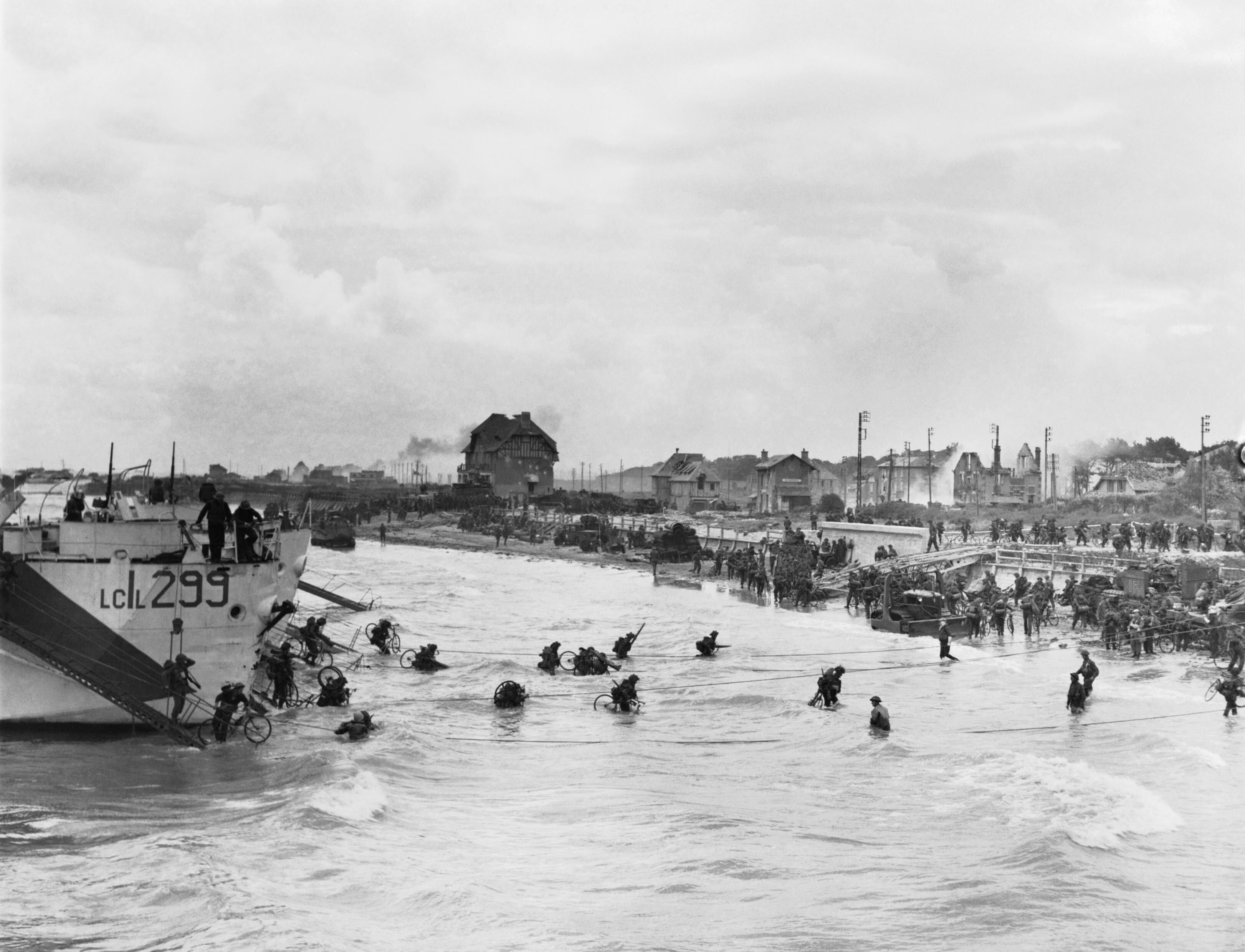
At 7:45 AM on 6 June 1944, the first Canadian landing craft ground onto the sands of Juno Beach in Normandy, France. Within hours, over 14,000 Canadian soldiers would wade through those waters, fight through fortified villages, and push further inland than any other Allied force that day. What happened on that eight-kilometre stretch of Norman coastline remains one of the most remarkable military achievements in Canadian history — and one of the most costly mornings any generation of young Canadians has ever faced.
A Nation Goes to War: Canada's Finest Morning
Canada in 1944 was a nation of just 11 million people. Yet by that point in the war, the country had already mobilised over one million men and women for the Allied effort — a feat of national will that still staggers the imagination. Juno Beach was assigned to the 3rd Canadian Infantry Division, and the sector stretched roughly eight kilometres along the Norman coastline, centred on the villages of Courseulles-sur-Mer, Bernières-sur-Mer, and Saint-Aubin-sur-Mer.
D-Day at Juno would prove to be the second costliest Allied beach landing of the day, surpassed only by the American catastrophe at Omaha Beach. That grim distinction should never be forgotten when assessing what Canadian soldiers achieved — they did it against some of the most heavily defended terrain on the Norman coast, and they did it almost entirely on their own terms.
Why Juno? Planning Operation Overlord's Canadian Sector
Operation Overlord planners assigned Juno to Canada partly in recognition of the country's enormous military contribution since 1939. The beach sat between two British sectors: Gold Beach to the west, assaulted by the British 50th Infantry Division, and Sword Beach to the east, held by the British 3rd Infantry Division. Holding the centre of that Allied line was no secondary role — it was the hinge on which the entire beachhead could succeed or fracture.
Canadian commanders had pushed hard for a prominent combat role, and for good reason. The catastrophic Dieppe Raid of August 1942 had cost Canada nearly 3,400 casualties in a single day, leaving a wound on the national psyche that demanded redemption. That disaster directly shaped Juno's assault planning: heavier naval and air bombardment, better intelligence, and a more carefully coordinated armoured support programme were all direct lessons drawn from the Dieppe failure.
There is even a small but telling footnote to the beach's name. The original Allied codename was "Jelly." King George VI reportedly requested it be changed, feeling the name was undignified for a place where men would die. It became Juno — and the name has carried weight ever since.
The German Defences: What the Canadians Were Up Against
Juno was defended primarily by elements of the German 716th Infantry Division, a static coastal defence unit whose men were a mixture of older Germans and Eastern European conscripts — but whose fortifications were anything but second-rate. Concrete bunkers, machine-gun nests, anti-tank obstacles including the infamous "Czech hedgehogs" and wooden stakes, and extensive minefields both on the beach and beneath the water made Juno a killing ground in waiting.
The offshore reef system posed a particular problem that planners struggled to fully solve. It forced landing craft to delay their approach, arriving later than on other beaches — giving German defenders precious additional minutes to recover from the pre-landing bombardment and return to their weapons. That delay, measured in minutes, cost hundreds of Canadian lives.
The villages themselves had been turned into fortresses. Houses were converted into strongpoints, streets were booby-trapped, and church towers served as observation posts for German artillery. Rough seas on the morning of 6 June swamped several landing craft before they even reached the shore, drowning men and destroying equipment before a single shot had been fired in anger.
H-Hour: The Assault on Juno Beach
Two brigades led the assault. The 7th Canadian Infantry Brigade attacked the western sector around Courseulles, while the 8th Canadian Infantry Brigade struck the eastern sector at Bernières and Saint-Aubin. The Royal Winnipeg Rifles and the Regina Rifle Regiment were among the first ashore at Courseulles, running into withering fire from German bunkers that the pre-landing bombardment had largely failed to destroy.
The Queen's Own Rifles of Canada landed at Bernières-sur-Mer and suffered the highest casualties of any Canadian unit that morning — 143 men killed or wounded within the first few minutes of touching the beach. Those men crossed open sand with almost no cover, facing machine guns that had survived the bombardment intact. The courage required to keep moving forward under those conditions is almost impossible to comprehend from a distance of eighty years.
One crucial element helped turn the tide. DD (Duplex Drive) Sherman tanks — amphibious armoured vehicles fitted with flotation screens — were launched offshore and, unlike the disaster at Omaha where most sank, the majority of Canadian DD tanks reached the beach. Their fire support gave infantry the cover they desperately needed to push through the German wire and into the village streets beyond.
By mid-morning, Canadian soldiers had fought through the beach defences and were moving into Courseulles and Bernières in brutal house-to-house combat — clearing rooms, fighting through gardens, and taking casualties at every corner.
The Men Who Led the Charge: Commanders and Heroes
Major-General Rod Keller commanded the 3rd Canadian Infantry Division on D-Day. A controversial figure among his peers, Keller nonetheless drove his division hard and achieved results that spoke for themselves. Brigadier Ken Blackader commanded the 8th Brigade and was one of the senior officers who had personally absorbed the hard lessons of Dieppe into his assault planning — the difference in preparation between 1942 and 1944 showed in every phase of the operation.
Company Sergeant Major Charles Belton of the Royal Winnipeg Rifles was one of countless NCOs who held their men together under devastating fire at Courseulles, rallying soldiers and helping break through the German defences when the attack threatened to stall on the waterline. It is men like Belton — rarely celebrated in the history books — who actually won beaches.
The soldiers themselves came from every corner of Canada. British Columbia fishermen, Ontario factory workers, Quebec farmers, prairie ranchers — many barely nineteen years old — found themselves fighting through Norman streets on one of history's most decisive mornings. They were volunteers, almost to a man, who had crossed an ocean to liberate people they had never met and would never see again.
Pushing Inland: Canada's Deepest D-Day Advance
By the afternoon of 6 June, Canadian units had advanced further inland than any other Allied force on D-Day — reaching up to eleven kilometres from the beach in places. The 1st Canadian Parachute Battalion, dropped overnight as part of the British 6th Airborne Division, had secured the left flank and linked with British forces pushing inland from Sword Beach, protecting the entire eastern edge of the Allied lodgement.
Canadian armoured units from the 2nd Canadian Armoured Brigade pushed toward the strategic Caen–Bayeux road, the N13, one of the key D-Day objectives. The village of Bény-sur-Mer was liberated by mid-afternoon. According to accounts gathered by Canadian military historians, the church bells rang out for the first time in four years — a sound that moved soldiers and villagers alike to tears.
Yet danger remained. A gap opened between the Canadian and British sectors near Sword Beach as the day wore on, and a German armoured counterattack by the 21st Panzer Division probed that seam in the late afternoon. It was one of the most dangerous moments of the entire D-Day operation. The counterattack narrowly failed to penetrate before darkness fell — a narrow escape that could have split the beachhead in its most vulnerable first hours.
The Cost of Courage: Canadian Casualties on D-Day
By nightfall on 6 June 1944, the Canadians had suffered approximately 1,074 casualties — 359 of whom were killed. The Queen's Own Rifles lost 143 men in the first assault wave alone. The Regina Rifles suffered 108 casualties fighting through Courseulles. The numbers are stark, but behind each one is a life cut short: a son who did not come home, a father whose children grew up without him.
Many of the dead were teenagers and men in their early twenties. The Bény-sur-Mer Canadian War Cemetery, established near the beaches, now holds 2,048 Commonwealth graves — the majority Canadian — arranged in immaculate rows that stretch across the Norman countryside. It remains one of the most quietly devastating places in France to visit.
And yet, despite the losses, Canadian forces had achieved every single one of their D-Day objectives. That is a military accomplishment without qualification — remarkable against a heavily fortified coastline, remarkable for any army in the world, and extraordinary for a country of eleven million people.
Aftermath: Canada's Role in the Battle of Normandy
The capture of Juno Beach secured the critical gap between Gold and Sword, preventing the Germans from splitting the Allied beachhead during its most fragile early hours. But the fighting was far from over. Canadian forces went on to bear some of the heaviest combat of the entire Normandy campaign, grinding through the approaches to Caen in weeks of attritional urban warfare.
The Falaise Pocket in August 1944 — in which Canadian and Polish forces played a decisive role — trapped and effectively destroyed a large part of the German Army of the West. It was a strategic victory of the first order, and Canada's contribution to it was indispensable. By the end of the Normandy campaign in late August 1944, Canada had suffered over 18,000 casualties — a staggering toll for a nation its size, and a measure of how hard Canadians fought every step of the way from the waterline to the Seine.
Juno Beach Today: Remembering Canada's D-Day
The Juno Beach Centre, opened in 2003 near Courseulles-sur-Mer, is the only museum in Normandy dedicated solely to Canada's role in the Second World War. It stands just metres from the waterline where the Royal Winnipeg Rifles and the Queen's Own Rifles came ashore under fire eight decades ago. Every year on 6 June, families, veterans' descendants, and thousands of visitors gather there and at the Bény-sur-Mer cemetery for commemorations that grow more poignant with every passing year.
The restored German bunkers at Courseulles — Widerstandsnest 31 and 32 — still squat on the beach, their concrete weathered but solid. Standing inside one and looking out across the sand toward the sea, you understand immediately what Canadian soldiers faced as they came out of their landing craft. There is no lecture or exhibition that communicates it as powerfully as that view does.
For many Canadians aged fifty-five and older, Juno Beach carries a meaning that goes beyond history books. A grandparent's medal in a drawer. A name on a cenotaph. A black-and-white photograph on a mantelpiece. These are not abstractions — they are the lived inheritance of what happened on that beach on a grey June morning in 1944, and they connect the present to one of the most important days in the history of the free world.
Further Reading
- Juno Beach Centre, Courseulles-sur-Mer, Normandy — the official museum dedicated to Canada's Second World War experience
- Library and Archives Canada — holds the official war diaries and records of the 3rd Canadian Infantry Division and all units involved at Juno Beach
- Canadian War Museum, Ottawa — home to the world's most comprehensive collection of Canadian military history, including extensive D-Day holdings
- Imperial War Museum, London — extensive archive of Operation Overlord planning documents, photographs, and personal testimonies from Commonwealth forces
- Commonwealth War Graves Commission — maintains the Bény-sur-Mer Canadian War Cemetery and holds records for every Commonwealth casualty of the Second World War