The Quiz Question
The 1917 Battle of Passchendaele, infamous for its sea of mud, is also officially known as what?
- A. The Third Battle of Ypres
- B. The Second Battle of the Somme
- C. The Battle of Cambrai
- D. The Battle of Arras
The answer is A. The Third Battle of Ypres. Here is the full story.
Say the word "Passchendaele" to anyone with even a passing interest in the First World War and you'll see a reaction. A slight wince. A shake of the head. In the century since the guns fell silent in Flanders, this small Belgian village has become one of the most potent symbols of human suffering in all of military history.
A Name That Still Sends a Shiver Down the Spine
The battle's official name — the Third Battle of Ypres — is largely unknown outside specialist circles. It is "Passchendaele" that endures, burned into collective memory as a byword for futility, mud, and industrial-scale slaughter. The village itself, now called Passendale, sits on a low ridge in West Flanders just eight miles from the town of Ypres. That eight miles took four months and hundreds of thousands of casualties to cross.
British Prime Minister David Lloyd George, who had authorised the campaign, later described it as having "no justification" — one of the most damning self-indictments in political history. Understanding why the battle was fought, and why it cost so much, means going back to the desperate strategic situation facing the Allies in the summer of 1917.
Why Ypres? The Strategic Context of 1917
By mid-1917 the Allied cause was in genuine crisis. The French Army had mutinied following the catastrophic failure of General Nivelle's spring offensive in April and May, leaving Britain's forces as the primary offensive power on the Western Front. The pressure on Field Marshal Sir Douglas Haig, Commander-in-Chief of the British Expeditionary Force, was immense.
Haig had long believed the Ypres Salient offered the key to a decisive breakthrough. The salient — a dangerous bulge in Allied lines, exposed on three sides to German fire — pointed toward the Belgian coast, and Haig's strategic vision was bold: break through, capture the ports of Ostend and Zeebrugge, and destroy the German U-boat bases that were strangling British Atlantic supply lines.
The Ypres Salient was already deeply symbolic. First Ypres in 1914 had seen the near-destruction of the original British Expeditionary Force. Second Ypres in 1915 had introduced the horror of large-scale gas attacks. A third great battle here carried enormous weight — strategic, military, and emotional. Lloyd George remained deeply sceptical, but with the French Army incapacitated, Haig argued Britain had no choice but to press forward and prevent Germany from exploiting the Allies' weakness.
The Ground Itself Was the Enemy: Flanders in 1917
No account of Passchendaele makes sense without understanding the terrain. The Ypres Salient sits on reclaimed marshland, its natural drainage maintained for centuries by a careful network of dykes, ditches, and channels. Four years of artillery fire had already shattered most of that infrastructure before the Third Battle even began.
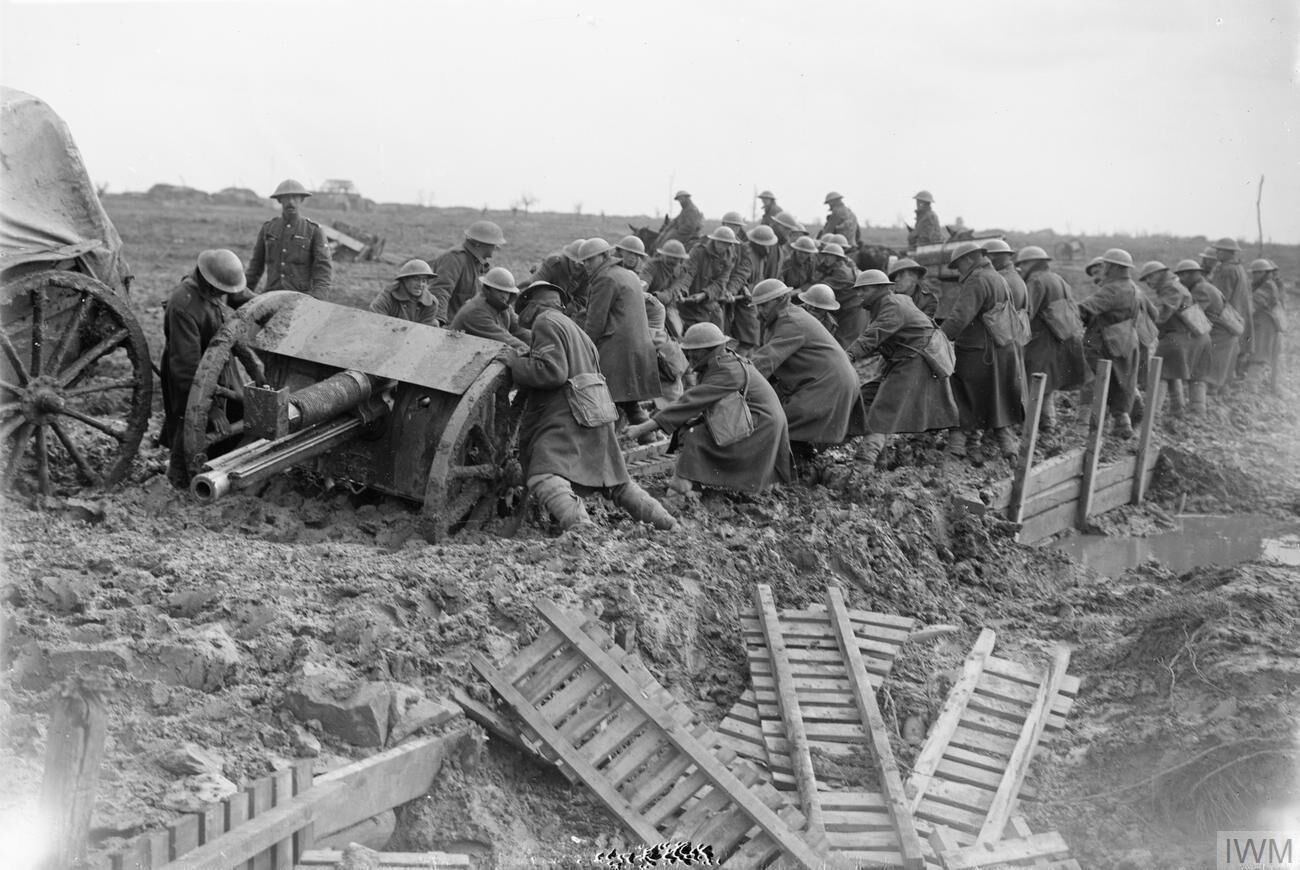
Then the weather turned. The summer of 1917 was one of the wettest in Flemish memory, with August rainfall more than double the seasonal average. British artillery fired over four million shells in the preliminary bombardment before the main assault on 31 July — and in doing so, destroyed the very drainage system the advancing troops would depend on. The result was a landscape of near-liquid mud, shell craters full of filthy water, and ground that could swallow a man to the waist.
This was not metaphor. Men, horses, mules, and equipment disappeared into the Flanders mud and were never recovered. The mud rendered artillery ineffective — shells simply sank before detonating — and turned every supply run into an ordeal of almost unimaginable difficulty. It is difficult to overstate how profoundly the ground shaped everything that followed.
The Battle Unfolds: July to November 1917
The Third Battle of Ypres officially opened on 31 July 1917 with General Sir Hubert Gough's Fifth Army leading the main assault. Early gains were encouraging, but German counter-attacks and the arrival of torrential rain halted progress within days. By early August the campaign had already begun to acquire its grim reputation.
In late August, General Sir Herbert Plumer took primary responsibility for the offensive and immediately changed approach. His "bite and hold" strategy — limited, carefully prepared advances supported by overwhelming firepower, followed by the consolidation of gains before pushing further — produced real results. The Battle of Menin Road on 20 September and Polygon Wood on 26 September were genuine tactical successes, demonstrating that even in Flanders, disciplined methodology could work.
But Haig, sensing a possible larger breakthrough, pushed on into October despite the worsening conditions. Command passed back to Gough, the weather deteriorated further, and the brief window of Plumer's careful progress closed. The Canadian Corps, under the capable and deeply reluctant General Sir Arthur Currie, were ordered in during late October. Currie reportedly warned Haig that the operation would cost 16,000 Canadian casualties — a prediction that proved grimly accurate. Haig pressed on regardless.
On 10 November 1917, men of the 1st and 2nd Canadian Divisions finally captured the ruins of Passchendaele village. There was almost nothing left to take. The "village" was a wasteland of rubble and water-filled craters, barely recognisable as a human settlement. The campaign was over.
The Men Who Fought: Faces in the Mud
Behind the statistics were individual human beings, and some of their stories give the battle its enduring emotional power. Wilfred Owen, who would become perhaps the most celebrated British war poet of the entire conflict, served near Ypres in 1917. The experience of the Salient fed directly into his poetry, including "Dulce et Decorum Est," with its unforgettable image of men stumbling through gas and mud.
Sergeant Lewis McGee of the 40th Battalion, Australian Imperial Force, won the Victoria Cross at Passchendaele on 12 October 1917. Under heavy fire, he single-handedly rushed a German pillbox, capturing it and enabling his company to advance. He was killed in action just weeks later. His story captures something essential about Passchendaele — extraordinary courage rendered almost invisible by the scale of the slaughter around it.
The battle was genuinely a British Empire effort. Australians fought at Broodseinde on 4 October in one of the most costly engagements of the entire campaign. New Zealanders suffered catastrophically at Gravenstafel on 12 October — a day remembered in New Zealand as one of the darkest of the entire war. South Africans, men from across the Caribbean, and soldiers from the Indian subcontinent all served in the Salient.
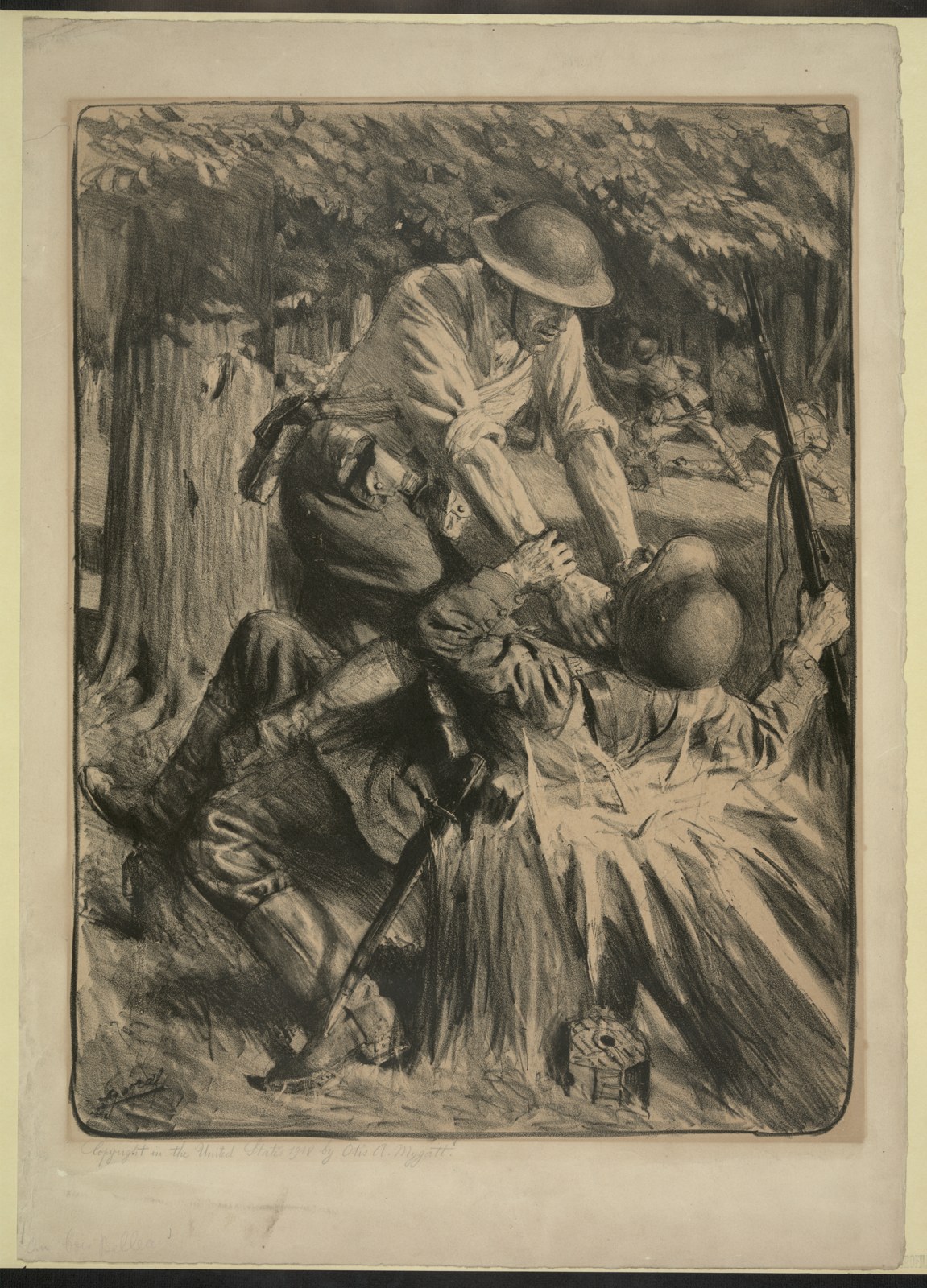
For the ordinary British Tommy, heroism rarely looked like a Victoria Cross action. It looked like carrying rations forward along duckboard tracks in pitch darkness, under shellfire, through mud that pulled at every step — and then doing it again the next night.
German Defensive Mastery: The Other Side of the Wire
It would be wrong to tell this story as though only one side was suffering. The German Army in Flanders had spent months constructing an elastic defence-in-depth — a sophisticated system of mutually supporting concrete pillboxes (called blockhouses), deep bunkers, and reserve counter-attack divisions positioned to strike before British forces could consolidate any gains.
General Friedrich Sixt von Arnim commanded the German Fourth Army in Flanders and implemented these tactics with considerable skill. His troops were trained to yield ground under the heaviest bombardment, shelter in deep concrete emplacements, and then counter-attack aggressively. German concrete pillboxes proved devastatingly effective — many survived direct hits from British artillery that would have obliterated any other field fortification.
Crown Prince Rupprecht of Bavaria, commanding German Army Group Flanders, later acknowledged that Passchendaele had cost Germany severely. German casualties for the battle are estimated at between 200,000 and 400,000 — the range reflects the genuine difficulty of establishing accurate figures, and the debate among historians continues. The battle ground down elite German divisions that were desperately needed elsewhere, including on the Eastern Front as Russia collapsed into revolution.
The Butcher's Bill: Casualties and Controversy
Total British and Empire casualties for the Third Battle of Ypres are generally estimated at approximately 275,000, though some figures run higher. The battle achieved an advance of roughly five miles at its deepest point — the Passchendaele ridge itself. It was terrain the Germans recaptured without serious resistance during the Spring Offensive of April 1918.
Haig's conduct of the campaign remains one of the most fiercely debated subjects in British military history. The "Butcher" charge — that he callously pressed men forward regardless of cost — sits uncomfortably alongside the countervailing argument that he was a commander doing the best he could in genuinely impossible circumstances, with a collapsing French ally and a government that withheld reinforcements while demanding results.
The controversy has even extended to the historical record itself. The Official British History of the campaign, compiled by Brigadier-General Sir James Edmonds in the 1940s, was subsequently examined by historians including Denis Winter, who argued that German casualty figures had been quietly inflated to make the battle appear more strategically justified than the raw evidence supported. The history of Passchendaele, it turns out, is contested even in its documentation.
Aftermath: From the Ridge to the Armistice
Within days of Passchendaele ending, Haig launched the Battle of Cambrai on 20 November 1917 — a surprise tank assault that briefly demonstrated what could be achieved on firm ground, away from the mud of Flanders. German counter-attacks ultimately erased most of those gains too, but Cambrai pointed toward the future of warfare in a way Passchendaele had not.
The ridge itself, purchased at such staggering cost, was abandoned without a fight in April 1918 when Ludendorff's Spring Offensives swept forward. It was on 11 April 1918 that Haig issued his famous "Backs to the Wall" order, calling on British troops to fight to the last man. The war's final, tumultuous chapter had begun.
Today the village of Passendale has been quietly rebuilt, a peaceful Flemish community with a small museum dedicated to the battle. A short distance away stands Tyne Cot Cemetery — the largest Commonwealth war cemetery in the world. It contains 11,956 graves and the names of nearly 35,000 men with no known grave inscribed on its memorial panels. Standing there, looking across that vast expanse of white headstones toward the low ridge the men fought so hard to reach, the human cost of those four months becomes almost incomprehensible.
Why Passchendaele Still Matters: Memory and Legacy
The centenary in 2017 brought renewed attention to the battle. King Philippe of Belgium and Prince Charles — now King Charles III — attended solemn ceremonies at Tyne Cot on 31 July 2017, marking a hundred years since the guns first opened. It was a reminder that for all the passage of time, this particular wound in history has never entirely closed.
Passchendaele has entered the English language as shorthand for pointless sacrifice — a cultural shorthand reinforced by novels, documentary films, and, perhaps most powerfully for British audiences, the BBC's Blackadder Goes Forth in 1989, whose final scene still provokes a stunned silence. Whether that cultural image is entirely fair to the commanders involved is a question historians continue to argue; what is beyond question is the scale of human suffering the name represents.
The battle also permanently changed how Australia, New Zealand, and Canada thought about their relationship with British high command. The losses sustained in Flanders accelerated a move toward greater Dominion military independence that would define how those nations fought — and remembered — the Second World War a generation later.
For all the controversy surrounding its command decisions, Passchendaele's deepest lesson may be simpler than any strategic analysis. The men who endured it — Lancashire mill workers, Melbourne clerks, Ontario farmers, Welsh miners — were ordinary people asked to do something extraordinary, and they did it with a resilience and courage that deserves to be remembered long after the arguments about their generals have faded.
Further Reading
- Imperial War Museum (IWM), London — extensive collections on the Third Battle of Ypres including personal diaries, photographs, and oral history recordings
- The National Archives, Kew — official British military records, war diaries, and operational reports from the Western Front
- Commonwealth War Graves Commission — records of casualties and cemetery information including Tyne Cot Cemetery
- Australian War Memorial, Canberra — detailed records of Australian units at Broodseinde and throughout the Ypres campaign
- In Flanders Fields Museum, Ypres (Ieper), Belgium — dedicated to the history of the Ypres Salient with primary source material and artefacts from the battles