The Quiz Question
Which aircraft was the most-produced American bomber of World War 2, with more than 18,000 built?
- A. B-17 Flying Fortress
- B. B-24 Liberator
- C. B-25 Mitchell
- D. B-29 Superfortress
The answer is B. B-24 Liberator. Here is the full story.
It is one of the great ironies of aviation history. The aircraft that was built in greater numbers than any other American bomber of the Second World War — over 18,500 of them rolling off assembly lines across five states — is not the one most people picture when they think of the Allied bombing campaign. That honour, fairly or not, belongs to the B-17 Flying Fortress. The B-24 Liberator, workhorse of the air war, has spent decades in its stablemate's shadow.
That imbalance deserves to be corrected. The Liberator flew in every theatre of the war, served with more than a dozen Allied nations, and helped deliver the sustained pressure on German industry, oil supply, and naval operations that the Allies needed to win. This is its story.
The Bomber That Outlasted Its Own Fame
When production finally ended in 1945, approximately 18,500 B-24 Liberators had been manufactured — compared to roughly 13,000 B-17s. No other American aircraft type came close in sheer output during the war years. Yet postwar films, memorials, and popular history consistently centred on the B-17, leaving the Liberator to fade from public consciousness with quiet unfairness.
Part of the explanation lies in the aircraft's own reputation among the men who flew it. Crews called it "The Flying Coffin" and "The Widow Maker." These were not terms of endearment. The B-24 was demanding to fly, uncomfortable to survive in, and less structurally forgiving than the B-17 when enemy flak or fighters tore into it. None of that, however, diminishes what it achieved. The Liberator was the backbone of Allied air power in ways the history books have been slow to acknowledge.
From Drawing Board to Runway: The B-24's Origins
Consolidated Aircraft Corporation began designing the B-24 in January 1939, responding to a US Army Air Corps request for a heavy bomber that could outperform the B-17 in range and payload. The project moved at a remarkable pace. Chief designer Isaac "Mac" Laddon made a critical early decision: the new aircraft would use the Davis high-aspect-ratio wing, a long, narrow configuration that promised superior fuel efficiency and extended range.
The prototype, designated XB-24, made its maiden flight on 29 December 1939 at Lindbergh Field in San Diego — less than a year after design work had begun. The RAF placed an early order in 1940, making the Liberator one of the first American aircraft to reach British service under pre-Lend-Lease procurement arrangements. Early variants were underpowered and lightly armed, but the B-24D model, introduced in 1942, gave the aircraft its mature form: four Pratt & Whitney Twin Wasp engines, self-sealing fuel tanks, and a defensive armament capable of holding its own against fighter attack.
Building an Arsenal: The Production Miracle
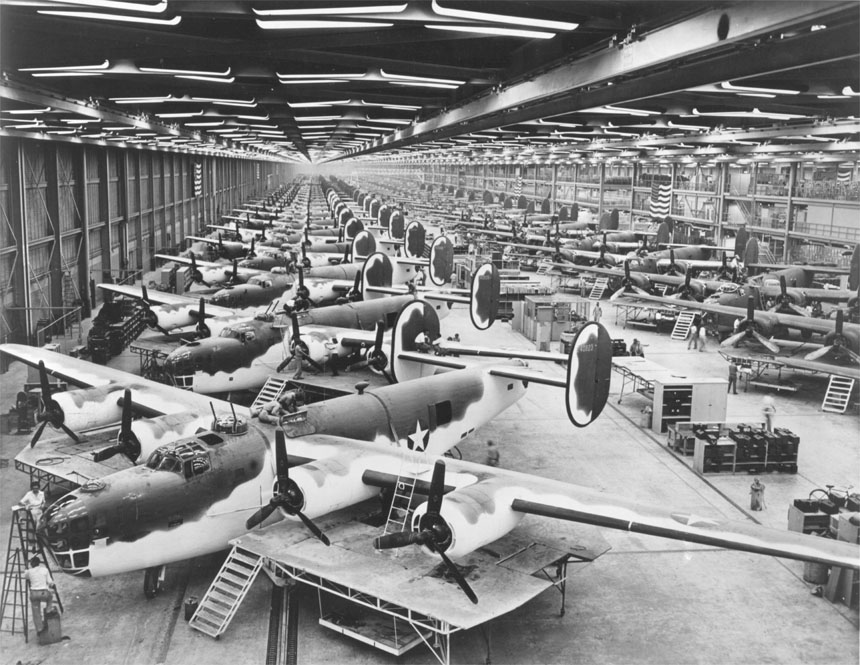
The scale of B-24 production remains astonishing even by modern standards. Ford Motor Company built a purpose-built facility at Willow Run, near Ypsilanti, Michigan, covering more than 300 acres under a single roof — at the time, one of the largest buildings in the world. At its 1944 peak, Willow Run was completing one B-24 every 63 minutes, employing around 42,000 workers, many of them women entering industrial employment for the first time.
Five manufacturers contributed to the total output: Consolidated at San Diego and Fort Worth, Ford at Willow Run, Douglas in Tulsa, and North American Aviation in Dallas. In 1944 alone, over 6,700 B-24s were delivered. The standardisation of components and the application of automobile-industry assembly techniques meant a Liberator could be built significantly faster than the more complex B-17. That production advantage translated directly into operational mass — more aircraft over more targets, sustained over a longer period than the enemy could absorb.
Into Battle: The B-24 in the European Theatre
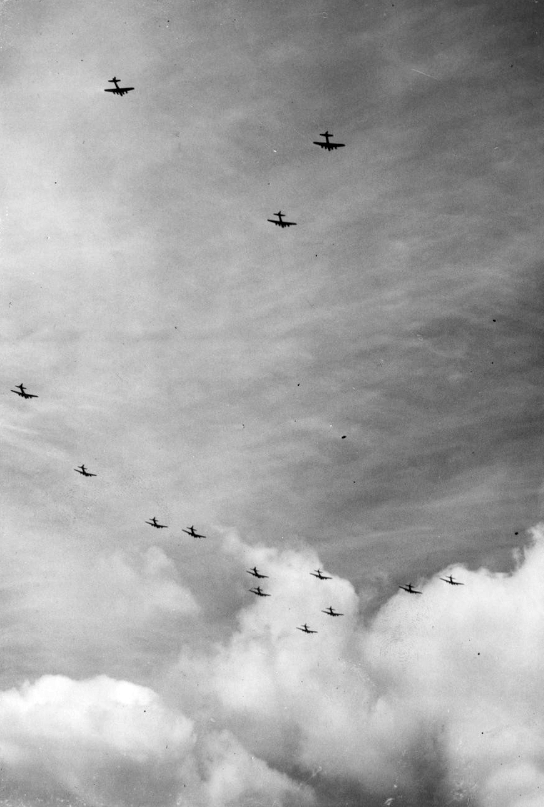
From 1942 onwards, B-24s of the US Eighth Air Force flew from bases in England as part of the Combined Bomber Offensive alongside RAF Bomber Command. The Second Bombardment Division, headquartered at Ketteringham Hall in Norfolk, was the primary B-24 formation in the United Kingdom, comprising dozens of bomb groups spread across East Anglia.
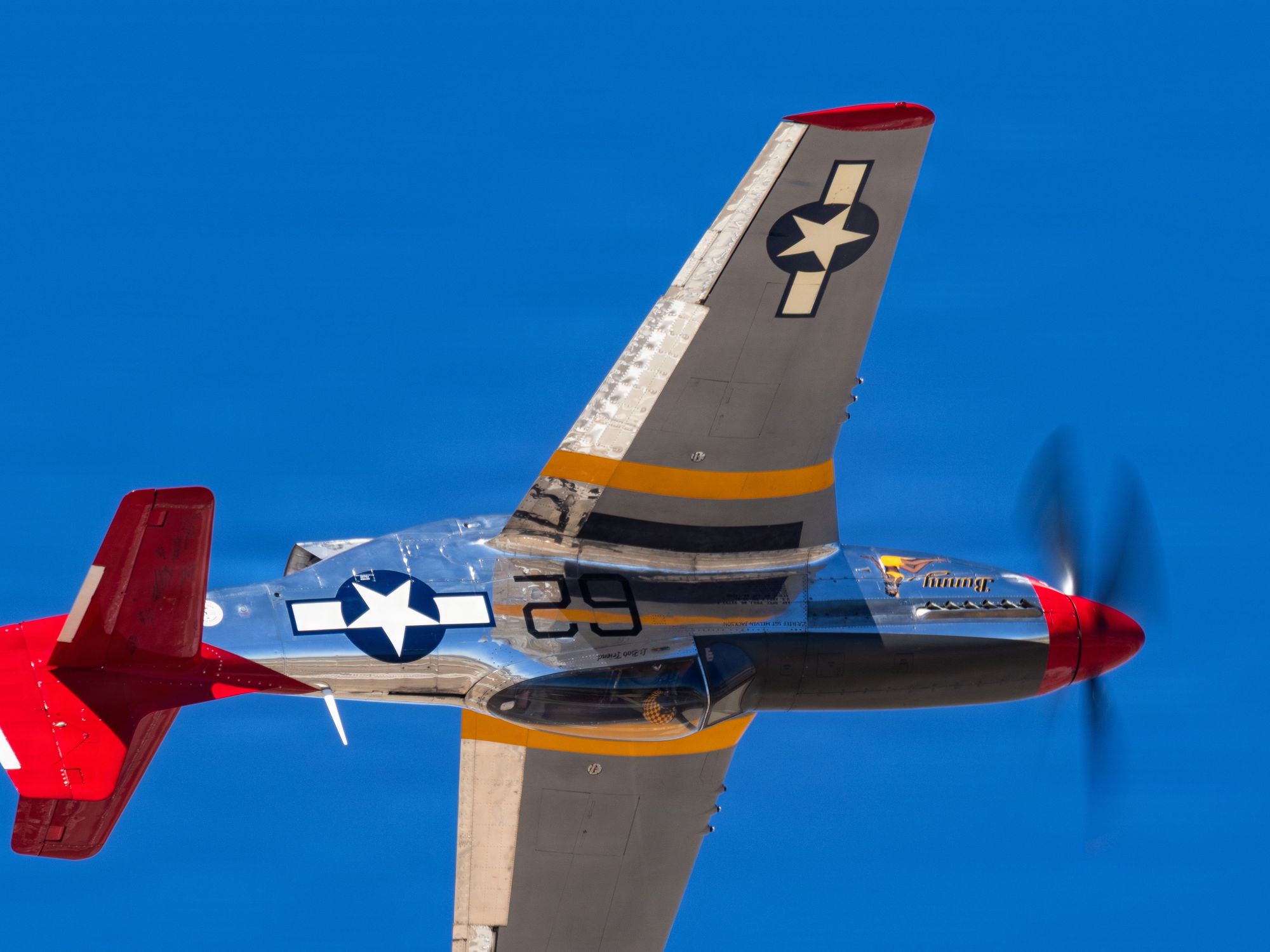
Targets included oil refineries, rail yards, and U-boat pens across Germany, France, and the Low Countries. The cost was severe. On missions to heavily defended targets such as Merseburg's synthetic oil plants, crew casualties could exceed 10% in a single raid. A full tour for Eighth Air Force bomber crews stood at 25 missions in 1943 — later raised to 30 and then 35 — and the statistical odds of completing it were ones that many men calculated with grim clarity before each departure. The arrival of long-range P-51 Mustang fighter escorts in early 1944 changed the arithmetic, but the losses already accumulated had been terrible.
Operation Tidal Wave: The Raid on Ploiești
No single mission defines the B-24's war more starkly than Operation Tidal Wave. On 1 August 1943, 178 Liberators drawn from five bomb groups departed Benghazi, Libya, bound for the oil refineries at Ploiești, Romania — a complex that supplied an estimated one-third of Germany's petroleum needs.
The plan called for a low-level attack, dropping to under 300 feet, to achieve surprise and accuracy. Instead, navigational errors over the Balkans scattered the formation, and the defences — which included anti-aircraft guns concealed among the refineries and fighter cover scrambled in time to meet the approach — turned the mission into a catastrophe. Fifty-three aircraft were lost, a casualty rate of nearly 30% of the attacking force. It remains one of the costliest single air missions of the war measured by percentage of force destroyed.
Five Medals of Honor were awarded for the Ploiești raid — more than for any other single military action in American history, according to US military records. Three were posthumous. Despite the extraordinary courage on display, the refineries were repaired and back to near-capacity within weeks, a sobering demonstration of industrial resilience in the face of strategic bombing.
The Pacific and Beyond: A Truly Global Aircraft
In the Pacific, the B-24's exceptional range — over 2,100 miles with a full bomb load — made it the natural choice for the vast distances of that theatre. B-24s of the Seventh and Thirteenth Air Forces flew extended over-water missions, attacking Japanese shipping, airfields, and island strongholds across the Central and South Pacific. The shorter-ranged B-17 simply could not cover the same ground.
RAF Liberators performed a different but equally vital role in the Battle of the Atlantic, equipped with radar and depth charges to hunt German U-boats in the mid-Atlantic gap — the stretch of ocean, sometimes called the "Black Pit," that shore-based aircraft could not previously reach. Their patrols, from 1942 onwards, helped close that gap and tipped the balance against the U-boat threat. In the China-Burma-India theatre, B-24s of the Tenth and Fourteenth Air Forces struck Japanese supply lines, bridges, and troop concentrations across Southeast Asia. Australian, Canadian, South African, and Indian Air Force crews all flew Liberators, making the aircraft a genuinely multi-national instrument of Allied strategy.
The Men Who Flew Her: Crew Life Aboard the B-24
A standard B-24 carried a crew of ten: pilot, co-pilot, navigator, bombardier, flight engineer, radio operator, and four gunners. The aircraft's twin-boom tail and distinctive Davis wing gave it an immediately recognisable silhouette, but also handling characteristics that demanded skill and concentration, particularly when flying the tight formations needed for mutual defensive fire.
At operational altitudes of 20,000 to 25,000 feet, temperatures inside the unpressurised fuselage could fall to minus 40 degrees Celsius. Frostbite was not a possibility; for gunners manning exposed positions, it was a near-certainty on long missions. The B-24's high-mounted wing carried fuel tanks that crews and accident investigators both noted were vulnerable to fire when hit — a fact that fed the aircraft's grim nicknames and shaped the visceral fear that accompanied every mission. Men who flew the Liberator were not unaware of what they had been handed.
B-24 vs B-17: Setting the Record Straight
The B-17's enduring fame owes much to wartime propaganda, Hollywood treatment — including the 1944 documentary Memphis Belle — and a more conventionally heroic profile. It is not primarily a reflection of operational superiority. The B-24 carried a heavier bomb load, up to 8,000 pounds operationally compared to the B-17's typical 4,000 to 6,000 pounds, and could fly further on the same fuel.
The B-17 held a genuine advantage in structural toughness: it was better able to absorb severe battle damage and still bring its crew home. Crews felt that difference acutely, and it shaped the Fortress's reputation in real time. General Jimmy Doolittle, who assumed command of the Eighth Air Force in January 1944, personally preferred the B-17 and shifted new bomb groups toward that type where possible — a command preference that had a measurable influence on postwar perceptions of both aircraft.
Historians now broadly regard the two bombers as complementary rather than competitive. Each had strengths the other lacked. But the sheer volume of B-24s built, and the breadth of theatres in which they served, makes the Liberator's contribution indispensable to any honest accounting of Allied air power.
Legacy: Why the Liberator Deserves to Be Remembered
Of the approximately 18,500 B-24s produced, only a handful of complete, airworthy examples survive. The Collings Foundation's Witchcraft — named in honour of the 130-mission record of a wartime Liberator — has been one of the most well-known flying examples, allowing veterans and new generations alike to experience the aircraft in the air. The survival of even a few aircraft is a small miracle given how thoroughly the post-war years consumed the wartime fleet.
The B-24's production story is itself a monument. No other nation involved in the Second World War could have built a single aircraft type at Willow Run's pace, in Willow Run's quantities, while simultaneously equipping allies across multiple continents. That industrial capacity was itself a weapon — perhaps the most decisive one the Allies possessed.
The Liberator helped close the mid-Atlantic gap, protecting the supply lines that kept Britain fed and fighting. It struck at the oil that powered German armour and aircraft. It ranged across the Pacific when no other bomber could cover the distances required. And it did all of this while being quietly unloved, unglamorous, and under-remembered.
If you found the B-24 Liberator's story as compelling as we do, share this article with a fellow history enthusiast — or leave a comment below telling us what you already knew about the Liberator and what surprised you. These stories deserve to be kept alive.
Further Reading
- National World War II Museum, New Orleans
- Smithsonian National Air and Space Museum, Washington D.C.
- Imperial War Museum, London
- National Archives and Records Administration (NARA), United States
- Air Force Historical Research Agency (AFHRA), Maxwell Air Force Base, Alabama