The Quiz Question
Which US submarine became the first vessel to reach the North Pole submerged, passing under the Arctic ice cap on August 3, 1958?
- A. USS Nautilus
- B. USS Triton
- C. USS Skate
- D. USS Seawolf
The answer is A. USS Nautilus. Here is the full story.
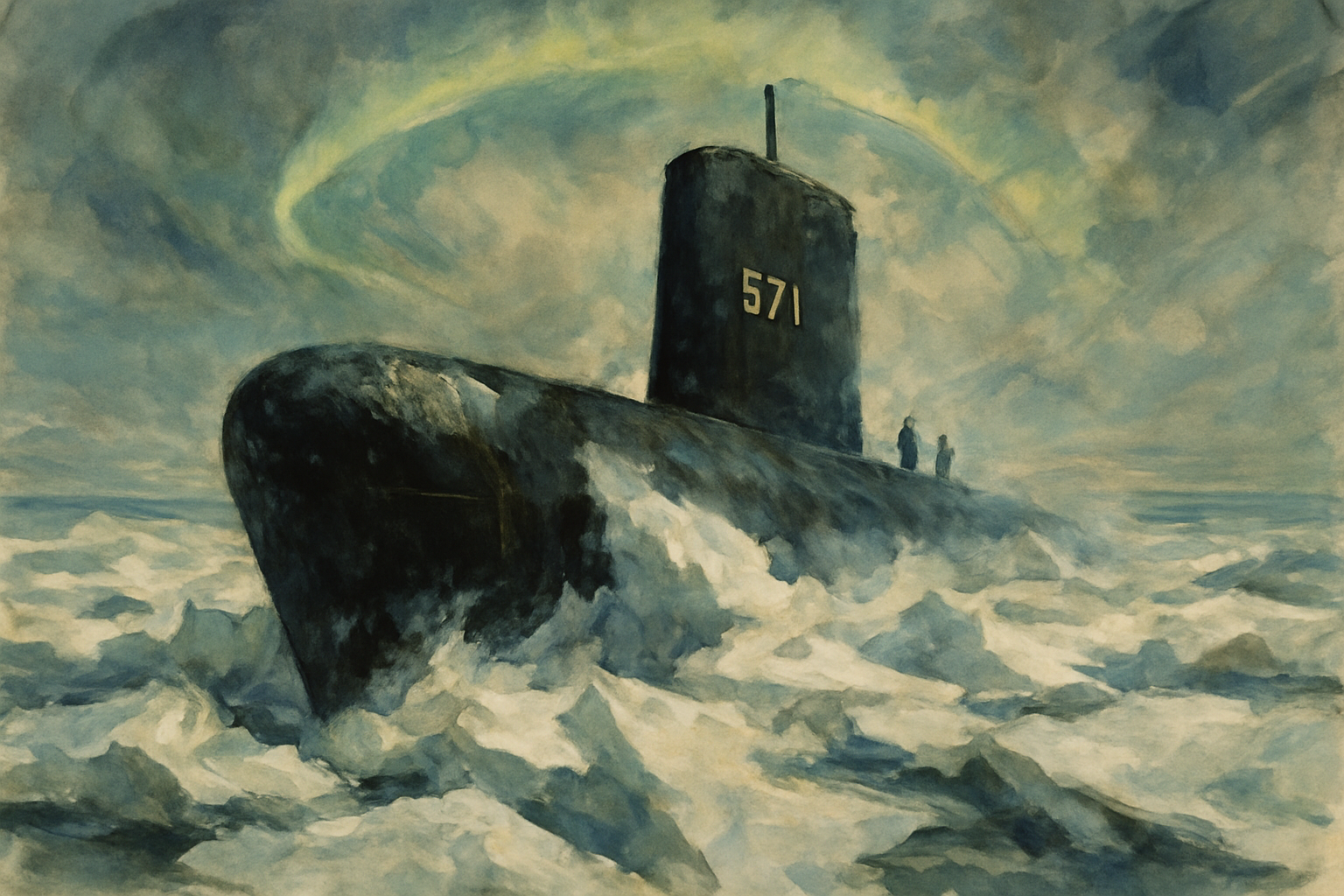
On 3 August 1958, at exactly 11:15 PM, a quiet cheer rippled through the control room of a United States Navy submarine cruising 400 feet beneath the Arctic ice. The navigation officer had just called out two words that no sailor in history had ever spoken in quite that context: ninety north. USS Nautilus had reached the geographic North Pole — and she had done it from underneath.
Under the Ice: The Day the World Changed Forever
The crew of Nautilus celebrated in near silence. They passed around a bottle of sparkling water — they were still on duty, still submerged, still threading through one of the most hostile environments on Earth. There was no champagne, no loud cheering. Just the hum of the reactor and the knowledge that they had done something no vessel in human history had ever done.
No surface ship had reached the Pole from below. No aircraft had flown beneath the ice. No human being had ever arrived at 90 degrees North through the deep ocean. This was genuinely uncharted territory in every sense of the phrase.
The mission, codenamed Operation Sunshine, had been so secret that most of Nautilus's own crew didn't know their true destination until they were already under way. When President Dwight D. Eisenhower announced the achievement to the world on 8 August 1958, he called it "a historic triumph of American science and sea power." Within hours, the story dominated front pages from London to Tokyo — and sent a message to Moscow that the United States could not have delivered more clearly with any weapon.
The Birth of a Revolutionary Vessel: USS Nautilus (SSN-571)
USS Nautilus was laid down at the Electric Boat Company in Groton, Connecticut, on 14 June 1952. President Harry Truman attended the keel-laying ceremony himself — a sign of just how significant the Navy considered this vessel to be.
She was launched on 21 January 1954, with First Lady Mamie Eisenhower christening her with the traditional champagne bottle, watched by thousands gathered on the banks of the Thames River. What slid into the water that day was unlike anything ever built: the world's first nuclear-powered submarine, driven by a Westinghouse S2W pressurised-water reactor capable of running for years without refuelling.
On 17 January 1955, Nautilus sent the signal that changed naval history: "Underway on nuclear power." Just four words. They announced the end of one era and the beginning of another.
Conventional diesel-electric submarines of the era needed to surface regularly — or at least snorkel — to recharge their batteries. Nautilus had no such limitation. She could remain submerged almost indefinitely, constrained only by the food supply and the endurance of her crew. That single fact rewrote the rulebook of undersea warfare.
Cold War Stakes: Why the Arctic Mattered So Much
By 1957, the Soviet Union had stunned the Western world with Sputnik — the first artificial satellite — demonstrating that Moscow was more than capable of matching American technology, and perhaps surpassing it. The space race and the arms race were running in parallel, and the United States was feeling the pressure.
The Arctic Ocean, largely ignored as a strategic corridor during earlier conflicts, had suddenly become critically important. It represented the shortest route between the American and Soviet heartlands — the path over the top of the world that nuclear-armed bombers had already begun to fly. A submarine that could operate freely beneath the Arctic ice was, in effect, invisible. No radar could find it. No satellite could track it. No surface patrol could intercept it.
US Navy planners understood exactly what this meant. A nuclear submarine transiting beneath the polar ice cap could carry ballistic missiles to within range of Soviet cities without ever being detected. Operation Sunshine was not merely an exploration — it was a strategic demonstration at one of the tensest moments of the entire Cold War.
The First Attempt: When the Arctic Pushed Back
Nautilus made her first attempt to cross the Arctic in the summer of 1957 — and was forced to turn back. The waters north of Point Barrow, Alaska, in the Chukchi Sea, proved far more treacherous than any chart suggested. Underwater ice keels — the jagged, downward-protruding ridges on the underside of pack ice — extended much deeper than expected, threatening to scrape or even rupture the hull.
Commander William R. Anderson, Nautilus's commanding officer, made the painful but correct decision to abort. He had 116 men aboard and a submarine whose loss would have been a catastrophic setback — strategically, scientifically, and in terms of public morale.
The Navy quietly regrouped. Oceanographers studied whatever sparse data existed on Arctic depths; there were almost no accurate depth charts for the waters beneath the ice cap. A second attempt in June 1958 was also aborted near the Bering Strait, again defeated by dangerously shallow conditions. The frustration aboard Nautilus was palpable — the crew knew they were close to something historic and kept being turned away at the door.
Operation Sunshine: The Run That Made History
On 23 July 1958, Nautilus departed Pearl Harbor, Hawaii, under sealed orders that most of her crew had not yet been permitted to read. Commander Anderson had decided to approach the Arctic from the Pacific, pushing through the Bering Strait and pressing further north than any previous attempt had dared.
The key insight Anderson applied on this third run was depth. By diving deeper and pushing past the treacherous shallows of the Chukchi shelf into the deeper waters of the Arctic Basin proper, he trusted that the ocean floor would open up and give Nautilus the room she needed. He was right.
On 1 August 1958, Nautilus slipped beneath the Arctic ice north of Point Barrow and began her historic transit at roughly 400 feet, moving at approximately 20 knots. Navigation was a formidable challenge: magnetic compasses become notoriously unreliable near the poles, where the magnetic field lines converge. The crew relied on an inertial navigation system — then cutting-edge technology — cross-referenced with gyrocompasses, to track their position with the precision the mission demanded.
Two days later, at 11:15 PM on 3 August, the navigation officer called out the coordinates. Ninety degrees North. The bottle of sparkling water was passed around. Nautilus was directly beneath the North Pole, and the world — though it didn't know it yet — had changed.
The Men Behind the Mission: Commander Anderson and His Crew
William R. Anderson was 37 years old in 1958, a Tennessee-born officer who had served on diesel submarines in the Pacific during World War II. He was precise, determined, and possessed of the particular quality essential in submarine command: the ability to make high-stakes decisions in confined spaces with incomplete information.
Keeping the true purpose of Operation Sunshine secret from most of his 116-man crew until Nautilus was well under way was no small feat — submarine life offers almost no privacy, and word travels fast in a pressure hull. Anderson managed it, which speaks to both his authority and the discipline of his crew.
The crew itself represented the volunteer tradition of the US Submarine Service — every man had chosen to be there. They ranged from seasoned petty officers with decades of service to young enlisted men in their early twenties experiencing their first major deployment. Dr. Waldo Lyon, an oceanographer from the Navy Electronics Laboratory in San Diego, sailed with them to conduct scientific observations — giving the mission a research dimension that would prove valuable long after the headlines faded.
After Nautilus completed her transit, Anderson was quietly flown ahead of the submarine to Washington, where President Eisenhower personally awarded him the Legion of Merit before the mission had even been publicly announced. The secrecy held, almost to the end.
Surfacing Into History: The World Reacts
Nautilus surfaced in the Atlantic on 5 August 1958. She had travelled 1,830 miles beneath the Arctic ice in just 96 hours — averaging roughly 20 miles per hour throughout the entire passage. It was, by any measure, an extraordinary feat of endurance and engineering.
President Eisenhower held the public announcement until 8 August, deliberately timing it for maximum global impact. It worked. The story dominated newspapers worldwide. Nautilus sailed into a hero's welcome, and Commander Anderson's memoir, Nautilus 90 North, became a bestseller that brought the story to a mass civilian audience — eventually appearing as recommended reading in American schools.
The Soviet news agency TASS responded with characteristic terseness. But Soviet naval planners did not respond tersely at all — they immediately accelerated their own nuclear submarine programme, understanding exactly what the transit meant for the strategic balance in the Arctic.
The Science Beneath the Ice: What Nautilus Discovered
Beyond the headlines, Operation Sunshine produced something of lasting scientific value: the first systematic depth soundings of the Arctic Ocean basin beneath the ice. Before August 1958, this data simply did not exist in any meaningful form.
Among the discoveries: the Arctic Ocean floor was dramatically more varied than anyone had assumed. The Lomonosov Ridge — an underwater mountain range that runs directly beneath the North Pole — was mapped for the first time with any real precision. Water temperature and salinity measurements taken during the transit transformed scientists' understanding of Arctic Ocean circulation and its relationship to global climate patterns.
The inertial navigation data gathered during the run was used to improve future polar navigation systems, eventually benefiting civilian Arctic shipping as well as military operations. And the strategic implications were immediate — the transit confirmed, definitively, that nuclear submarines could operate in Arctic waters year-round, a fact that reshaped naval doctrine on both sides of the Iron Curtain.
Legacy of the Nautilus: A Turning Point in Naval History
USS Nautilus was decommissioned on 3 March 1980, having logged over 500,000 miles in service. She is now preserved as a museum ship at the Submarine Force Museum in Groton, Connecticut — the same city where she was built, in a fitting symmetry.
Her Arctic transit had direct consequences for Western defence strategy. The concept of a nuclear-armed submarine striking from beneath the polar ice became the cornerstone of the Polaris missile programme — the foundation of Western submarine-based nuclear deterrence for a generation. The Royal Navy, watching events closely, accelerated its own nuclear submarine programme; HMS Dreadnought, Britain's first nuclear submarine, was commissioned in 1963 in direct response to what Nautilus had demonstrated.
In March 1959, USS Skate went one step further — becoming the first submarine to actually surface at the North Pole, breaking through the ice itself. Each mission built on the last, and all of it traced back to the night of 3 August 1958.
Operation Sunshine remains one of the defining moments of the Cold War — a bloodless victory won not with missiles or bombs, but with engineering, courage, and the sheer audacity of going where no vessel had ever gone before. It proved that American ingenuity could project power in ways that no adversary could easily counter, and it did so without firing a single shot.
If this story stirred something in you — the quiet drama of that control room, 400 feet below the ice, as a navigator called out ninety north — we'd love to hear your thoughts. Share this article with a fellow history enthusiast, or leave a comment below telling us what aspect of Operation Sunshine you found most remarkable. These stories deserve to be kept alive.
Further Reading
- Submarine Force Library and Museum, Groton, Connecticut
- Naval History and Heritage Command, Washington DC
- Smithsonian National Museum of American History
- The National Archives, Washington DC
- Naval Institute Press (US Naval Institute, Annapolis, Maryland)